An Introduction to Jo Kondo’s Sen no Ongaku Music of 1973 to 1980
John
Cole
The
composer Jo Kondo has a very special position in contemporary music, not just in
his home country but internationally. Along with teaching in Japan (at present,
he holds a professorship at Ochanomizu University in Tokyo, and continues to
teach a composition class at Tokyo University of Fine Arts and Music). He has
taught in England, Canada and the United States and he is a prolific writer,
author of five books and over one hundred publications on topics covering all
musical matters ranging from his own music and music aesthetics, to interviews
with important contemporary composers. While Kondo's music has been discussed
in various publications, an examination of his entire body of work has not yet
been attempted.
An
examination of Kondo’s entire oeuvre shows a surprising consistency of style in
works from 1973 to the present. Kondo
refers to this style as "sen no ongaku" which he translates
into English as "linear music". One of the main objectives of this
study is to show how Kondo is able to adapt the essential elements of sen no
ongaku to compositions of various instrumental combinations and scale, from
solo and chamber works, to compositions for much larger ensembles and
orchestral pieces. The year 1973 is significant as it was the year Kondo
started overtly composing with sen no ongaku, and the year 1980
represents a change in style in which vertical relations became emphasized over
horizontal relations. Thus, examining in detail the pieces from 1973 to 1980 it
will be possible to contextualize the origin and particular points of
development of sen no ongaku in Kondo’s music.
Another
of the decisions made at the onset of this study was to limit the discussion to
a concrete examination of his scores and recordings. While some aesthetic and philosophical
problems are touched on, this enquiry is concerned in no way with any extra‑musical
or philosophical concerns outside the music itself. Thus wherever possible, an
attempt will be made to rely on aural confirmation in recordings and to avoid
both claims based on score analysis without connection to the concrete sound,
and the search for obscure and impalpable theoretical connections.
The
Earliest Definition of 'Sen no ongaku '
Chronologically,
the first mention of the term 'sen no ongaku' in the composer's writings
is found in the liner notes of the album of the same name released in
1974. These were written to briefly
introduce his new theory and to explain the compositional methodology of Orient
Orientation (1973), Standing (1973), Falling (1973), Click
Crack (1973), and Pass (1974)
recorded on this album.
Kondo
begins the explanation of the his new theory as follows:
"Sen
no ongaku" can be roughly translated as "linear music". At first this music will sound to most people
like a row of endless tones that proceed without interruption, always wrapped
out in a kind of simple artlessness.
Let
us begin examining Kondo's description of sen no ongaku as "a row
of endless tones," a phrase which aptly applies to the first sen no
ongaku work Orient Orientation written for any two melody instruments
of the same kind (Example 1).
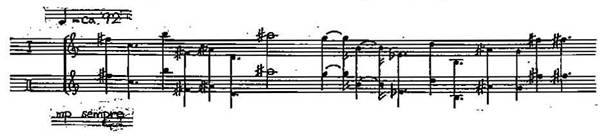
Example 1: Orient
Orientation: page 1, first system
If
we glance at an excerpt from a stylistically quite different work from the same
year as Orient Orientation we can see the manner of working with a
"row of endless tones" expressed in a slightly different way (Example
2).
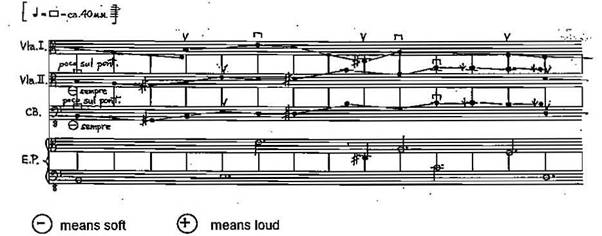
Example 2: Falling: page
2, first system Dynamics
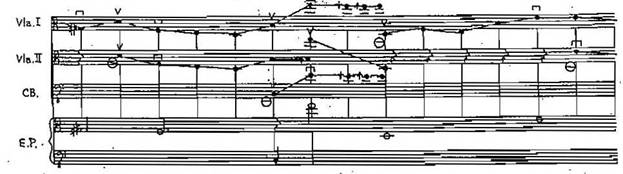
of the sounds of electric piano are always free between ppp and mp.
Here,
in Falling for 2 violas, double bass and electric piano, we have a
four-part texture of four rows of tones. The row of tones of the electric piano
part, which is very similar in character to the Orient Orientation rows,
is combined with the three rows of tones written for the two violas and
contrabass. In this example the slanting
lines in the string instruments represent glissandi. Due to the consistent use
of glissandi throughout the composition, these string instrument parts, while
incorporating visibly linear note rows, have a very different sound quality
from the rows of the electric piano part. In this context, due to the absence
of a clearly articulated series of individual attacks, the rows written for the
three string instruments have the quality of continuous undulating waves of
sound. In Falling, Kondo is experimenting with "a time lag shift in
the mobility of a sound that keeps neither fixed pitch nor dynamics."
The
following two lines from Click Crack for solo piano present another slightly
different treatment of a row of tones (Example 3).
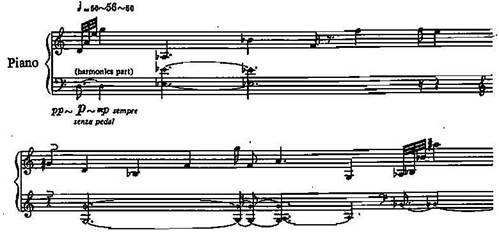
Example 3: Click
Crack: page 1, first 2 systems
In
this example the row of tones in the upper staff is combined with an extremely subtle
chordal accompaniment of barely audible piano string harmonics in the lower
staff. By silently depressing the keys of the piano (the diamond shaped
pitches) while playing the upper line, these harmonics are made audible through
the sympathetic resonance of the undampened strings. Due to the incorporation
of rapid groupings of thirty‑second notes, the note row in the upper
staff is more florid and gestural than the note rows of the two previous
examples.
In
Standing, written for three instruments of different families, we
recognize a degree of complexity not encountered in the previous examples
(Example 4). Complexity in this example arises from three conditions. First,
the rows of tones in this composition are distributed among three, rather than
one or two voices. Second, most of the composition is made up of two
independent lines moving in tandem, creating harmony in the form of two‑note
chords, which has the effect of blurring the boundaries between the two lines. Third,
the direct note repetitions distributed among the three lines continuously vary
in number, creating very irregular rhythmic patterns.
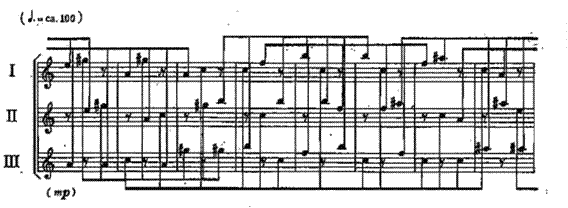
Example 4: Standing:
page 15, first system
After
explaining the outward appearance of the new sen no ongaku style as a
"row of endless tones," Kondo moves on to discuss the specific
functions of sound groupings which "enable the listener simply to gaze at
each sound dispassionately¼." It is important to note this first mention of
Kondo's concern with the relationship between sound groupings and listening as
it forms such an important role in subsequent writings.
The
next important point in Kondo's introduction to sen no ongaku style is
his concern with the "spatialization" and "positionings" of
tones in a sound‑space. He writes:
Each
single tone we deal with is not a self‑sufficient, indivisible particle,
but one that has been spatialized ¼ each
spatialized single tone ¼ endlessly
uncovers manifold positionings in that sound‑space.
Kondo's
idea of "manifold positionings" can best be explained with reference
to the formation of melody. A “melodic grouping” is a collection of tones
grouped in a relatively tight unit in which each individual tone contributes in
some way to the perception of the whole as a single entity. If single tones are
grouped too far apart, the tones are not perceived as being connected to each
other, and consequently, the sense of these tones forming a melody is weakened,
or even non‑existent, depending on the distance between individual tones.
In the case of conventional melody the individual notes must sacrifice some of
their individual identity in order to form a grouping which can be registered
by the listener as a single entity. In this sense, a note within a melody has a
relatively restricted "positioning" in relation to the notes
surrounding it. To cite a rather obvious example, if the notes of any well‑known
melody are slightly re‑arranged, the tune is rendered incomprehensible. Or
if a melody's tempo is altered considerably it might not be perceived as
melody, but rather as “figuration”, or even “texture”.
Kondo's
note rows of sen no ongaku works are very close in character to
conventional melodies in terms of their continuity and general contour. But
they lack the specific fixed "positionings" of individual notes
grouped in such a way that a clear melody is perceived. The main aspect of
melodic tone grouping that Kondo is interested in preserving is the manner “of
note‑binding”, or a note's potential for connection with other notes. If
the note rows stray too far from conventional melody, with too few or no
connections between tones, the groupings tend to resemble chance music where a
sound's particular positioning in relation to other sounds is redundant.
Because
the “binding relations” of sen no ongaku tone rows are not as rigidly
fixed as conventional melody, the individual notes have more autonomy, and are
capable of being positioned in a great variety of potential groupings or
"manifold positionings." Because of the relative looseness of the
groupings, a row of a sen no ongaku work may be interpreted in a myriad
of ways depending on the particular predilection of each individual
listener.
Finally,
and most importantly, one of the most definitive aspects of sen no ongaku
is the musical continuity which Kondo explains in the following manner: "'Linear
Music,’ considered as a row of tones articulated in single note units, acquires
a continuity based on an endless pulse." These words of Kondo written in 1974,
succinctly define an important aspect of sen no ongaku which we will
examine repeatedly and in detail throughout
the analyses of this study.
Terminology:
“Sound Shadow” and “Sound Grouping”
Two
important terms appearing for the first time in the liner notes of 1974, which
Kondo used to explain his new theory of sen no ongaku were “sound
shadow” and “sound groupings.” Defining Kondo's “sound shadow” in a concise
manner is difficult as the only written description of the term by the composer
in the liner notes to his first LP album, is somewhat abstruse.
The five works on this album however, suggest certain concrete implications of the
term. While ‘sound shadows’ can take many forms, one of the more common of
these is that of a tone or continuous sound directly following a leading voice,
most often in the form of a staggered repetition of a single note. The ‘sound shadow’ technique first appears in
the very first work written in sen no ongaku style, Orient
Orientation (Example 5).
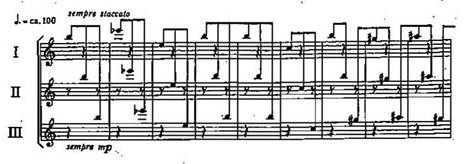
Example 5: Orient
Orientation: page 2, system 7
(The
instrumentation of this work is for any two melody instruments of the same kind)
In
some works the sound shadow can be likened to a hocket‑like effect as
below (Example 6).
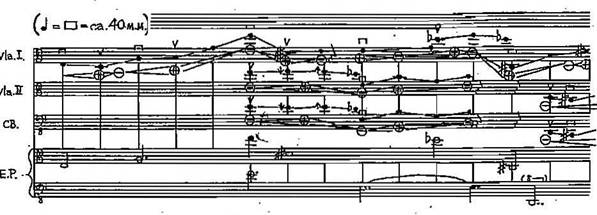
Example 6: Standing:
page 1, system 1
In
other works the “sound shadow” manifests itself as an asymmetrical sound
aggregate or “echo”. In Falling (Example 7) the leading first viola line
follows the attacks of the electric piano "with a moving shadow that tries
to coincide with them."
This first viola line is then “shadowed” by the second viola and double bass
playing in two‑octave unison.
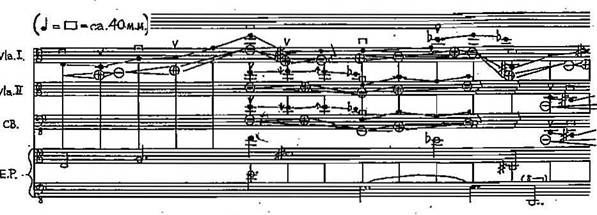
Example 7: Falling:
page 2, system 4
The
more thickly textured work Pass, written for a slightly larger ensemble of
banjo, two guitars, taisho‑koto, harp and harmonica, displays the freest
use of the “sound shadow” technique so far (Example 8).
In
this work the “sound shadow” is not readily discernable. Kondo explains this
veiled “shadow articulation” in the following way: "Here the shadow is
allowed free motion, it is even provided with an independent structure that
could almost be called a figure for each instrument."
The banjo in this work has the central role of "carrying"
the sound shadows of the other instruments. Because the instrumental lines are
so rhythmically varied, the resulting articulation of their shadows is quite
irregular. This technique of “shadow articulation” is very different in
character from that seen in Examples 5 and 6.
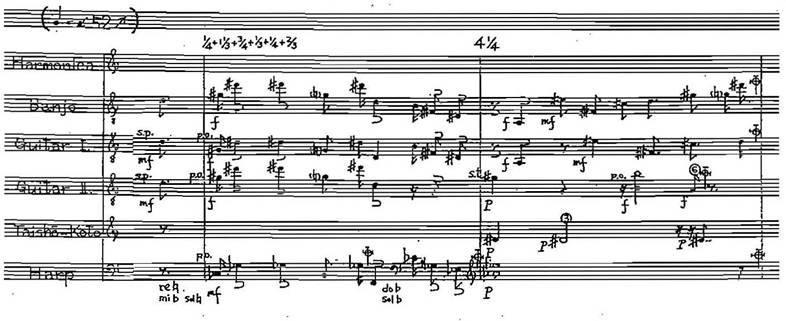
Example 8: Pass:
page 9, system 2
The
function of the “sound shadow” is to draw attention to the note sounding
immediately before, in order to reinforce the independence of this note as an entity
in and of itself. The reciprocal relationship between sounds and “sound
shadows” employed here has the dual function of not only drawing the listener's
attention toward the individual tones, but also of discouraging the tendency of
the listener to hear the pitches as part of larger conventional melodic
groupings.
As
we can see from the above explanations, it is clear that for Kondo,”‘sound
shadows” have two functions. The first is the framing of individual tones in
order to highlight their independence from each other, and the second consists
of the "positioning of tones within a compatible succeeding
relationship" through the delicate rhythmic placement of the shadow tone.
Kondo's conception of a “row of tones”
here is far from structural. For him a row of tones is less a collection of
material for building and constructing, than a random selection of pitches used
for experimenting with “shadow articulation”. The consistent use of “shadow
articulation” throughout a work is one method used by Kondo to avoid the
formation of conventional note groupings.
The
term “sound groupings" refers to the way pitches are arranged in a
composition. Stated simply, they can be grouped in one of two ways: vertically
(harmonically) or horizontally (melodically). While both methods of grouping
are used in Kondo's linear music, in most of the works from the first period
horizontal groupings of sounds are more prominent than vertical groupings.
Before
moving on to a detailed description of the note rows an important point in the
definition of a sen no ongaku row must be clarified, namely that Kondo's
definition of a sen no ongaku row should not be confused in any way with
a 12‑tone row or a serial row. Kondo later uses the term “pitch gamut” to
dispel any connection with the latter two terms.
One of the most important distinguishing features of linear music pitch gamuts
is their 'non structural' nature.
Kondo's
theory of sen no ongaku centered on a new method of grouping sounds.
This new method of organization or "spatialization" of pitches
avoided strong tonal centers, melodic climaxes and functional harmony. “Pitch
gamuts” in linear music can be considered to have a loose correspondence to a
“tone row” or melody, but due to the lack of tight groupings of notes, the
often rhythmically irregular positioning of sounds in time, and the careful
attention given to the self‑sufficiency of each sound in the line, we
must consider Kondo's horizontal groupings of tones a radical departure from
the idea of melody in the conventional sense.
Kondo's
horizontal groupings differ further from traditional melody in their
aimlessness or non‑directionality. Because Kondo's “rows of tones” are
organized in a non‑hierarchical manner with a clear absence of
goal-directed movement, the individual notes of these rows float in time in an
often rhythmically and harmonically ambiguous state. The most important
objective of this new pitch organization is the maintenance of the self‑sufficiency
of each tone when it is sounded. Whil we can consider Kondo's pitch gamuts as a
kind of structural foundation of each work, they are not treated in a
conventionally structuralist manner.
That is to say that the individual pitches of these gamuts are not
combined in sound groupings to form a greater whole, but are rather grouped in
a manner that encourages their mutual independence, a kind of semi‑autonomous
state.
Kondo's
intention here is to encourage a different kind of listening ‑ an
attention to individual sounds over conventional melodic and harmonic groupings
of sounds. This is not to say that Kondo is unconcerned with the relationships
between the individual sounds but rather that he wishes to avoid "the
problem posed by sound grouping¼centered
on the structure of sound aggregates [resulting] from the accumulation of
tones"
which suggest conventional expressive melodic formations.
In
order to encourage this kind of listening, the particular manner in which sounds
are grouped is of the utmost importance. If certain sounds in a pitch gamut are
placed closer together than others, the ear naturally groups them as a
distinctively identifiable unit setting them apart from other less dense
groupings. If, on the other hand, all pitches are placed relatively equidistant
from each other, the individual tones lose their self‑sufficiency and are
subsumed into a rhythmically static whole. Kondo is interested in creating an
ambiguous state in which note groupings of greater or lesser density cannot be
readily distinguished from each other. The composition of these early linear
music works represents Kondo's first grappling with a delicate balancing act ‑
a searching for a means of grouping sounds to achieve what he later termed
"the proper degree of ambiguity and vagueness."
He explains his theory of the function of note groupings in the following
manner:
¼if the
groupings are too vague, the sounds lose their mutual relationships, and the
outcome resembles Cage's chance music. If on the other hand, the groupings are
too unambiguous, the listener ends up listening only to the resulting structure
and falling prey to its expressive effects. It is essential to find the proper
balance, an arrangement where sounds are heard as mutually connected by
groupings, and yet each sound keeps its own individuality without becoming
completely submerged under the upper level structures.
Kondo
explains this balance in more concrete terms when speaking about Sight
Rhythmics (1975) in the same article:
In short there is a melody‑like
structure, but it is never unambiguously established; it is almost a melody,
yet not quite. The listener can feel that a melody‑like structure exists
(which is precisely the syntactic device I use to bind the individual sounds
together), but he is still able to recognize each individual sound in its own
right. He perceives the individual
sounds through a 'melodic prism' as it were.
As
we can see from these two quotations, Kondo's theories regarding sound
groupings extend beyond a purely structural concern with how pitches can be
ordered or combined in a composition to form a coherent whole as in Schoenberg.
It is through the employment of a melody‑like structure that Kondo is
able to focus on what interests him most ‑ encouraging of an active kind
of listening, from instant to instant, in which the listener groups the
individual sounds of the work into various configurations based on their own
preferences.
Almost
all of the works composed in this period conform to the characteristics of the
new, sen no ongaku style in terms of their extremely sparse texture,
static quality and the use of a single melodic line as their basic material. From
1973 Kondo had found his voice, and in this year alone wrote no less than six
works to outline his new theories. The abrupt shift in style in 1973 was a
conscious one as we can see from his desire to explain his new theory in detail
in the first two chapters of his book Sen no ongaku. This stylistic
shift is even more striking in retrospect when we consider how important the
ideas outlined in Sen no ongaku were in the formation of a distinctive
style, which can be recognized throughout the composer's entire body of work
from the first “linear music” pieces to the present.
There
are a few works in this period, however, which do not so easily conform to the
characteristics of the new, sen no ongaku style. We will begin this section with a brief
discussion of these works. These exceptions are Mr. Bloomfield, His Spacing
(1973) for string quartet, MINE (1974) for chorus, Ashore (1974)
a work of indeterminate duration for tape, flute, piano, electric organ, harp
contrabass, percussion and harmonica, Kekai‑Sekai (1976) for mixed
chorus and Riverrun (1977) for tape. We will focus on only one of these
works, Mr. Bloomfield, His Spacing, which retains aspects of both pre‑sen
no ongaku and sen no ongaku style.
Mr.
Bloomfield, His Spacing
Mr. Bloomfield, His Spacing, for string quartet and
cowbells, is somewhat hard to categorize stylistically.
Although it was written after Orient Orientation, and does display some
characteristics of sen no ongaku, in terms of its overall sound world
and quality of musical gestures, this composition has affinities with the
pieces written before 1973. In particular it has a certain likeness to the
earlier work Breeze (1970) through its use of graphic notation,
labyrinthine instructions for the four performers, its focus on attentive
listening, and its experimental atmosphere. It has connections to the new sen
no ongaku style in terms of its formal clarity, stark reduction of musical
material, and fixation and limitation of musical elements. Perhaps most
importantly, this is the first composition to use rhythmic unison which is the
most important structural aspect forming the backbone of almost all works
written in sen no ongaku style.
Mr. Bloomfield, His Spacing was the last piece
in Kondo's oeuvre to include extensive detailed instructions for the
performer. It is one of only four works
by the composer written in graphic notation.
From this point on, with only one exception (Jo‑ka), all of
Kondo's work is conventionally notated.
The score includes five charts with an accompanying page of
instructions. One of the five charts (referred to as Chart 1 in Kondo's
instructions), is a scordatura and fingering position chart for the four
string instruments (Example 9).
The
remaining four charts (lettered A, B, C and D in the score), are written in
graphic notation. Because all four charts are so similar in appearance, we need
only refer to one example. Chart A is shown below (Example 10). Because the
instruction sheet explaining this chart is so comprehensive, it is included
here in its entirety. A quick glance through this page of instructions is the
simplest way of grasping the technical details of the work.
Kondo
favors a strict reduction of material and fixation and limitation of musical
events to create his musical image. Kondo's directions are very concise with
the single parameter of pitch being the only indeterminate element of the
composition. Compared to the work Breeze, which also employs
indeterminate elements, Mr. Bloomfield, His Spacing is a much more
tightly controlled work. This control is manifest in the notation, through the
very clear treatment of the four parameters of pitch, duration, dynamics and
timbre.
The
most notable aspect of Mr. Bloomfield, His Spacing is that Kondo is able
to articulate such a clear musical image through graphic notation. An important aspect of this notation is the
careful balancing of indeterminate and determinate elements. If indeterminate
elements are too predominant, formal clarity is lost. On the other hand, if every musical parameter
of the work is too tightly controlled, the piece loses flexibility and
spontaneity, which are both essential qualities contributing to the playful
atmosphere and character of the composition.
An
unusual feature, which contributes greatly to the character and identity of
this work is the inclusion of four cowbells, each of different pitch to be played
by the four string players. Kondo uses the cowbells in a structural, rather
than coloristic manner, to punctuate pauses at the ends of musical lines, and
to amplify breaks in continuity. The inclusion of these unusual non‑pitched
instruments into an otherwise conventional ensemble is a device used by Kondo
to offset the listener's expectation, by adding an unstable element into an
otherwise conventional sound world. We will see this technique in many future
compositions.
The clarity of the piece can be seen in the
way Kondo organizes large sections of material in a strict formal scheme. In
the top right hand side of the sheet of instructions (Example 11) we see a
figure designating the particular order in which charts A to D are to be played
by each performer. The work is divided into two major sections which Kondo
terms "cyles." The partitioning of the work into two contrasting
cycles is an important formal stratagem which helps to structure the work in
two important ways. First, the re-inclusion of the A and B charts from Cycle 1
in Cycle 2 aids in the comprehension of a quite abstract sound world through
repetition. Second, a kind of musical development is suggested through the
introduction of new material (charts C and D only) in the second cycle.
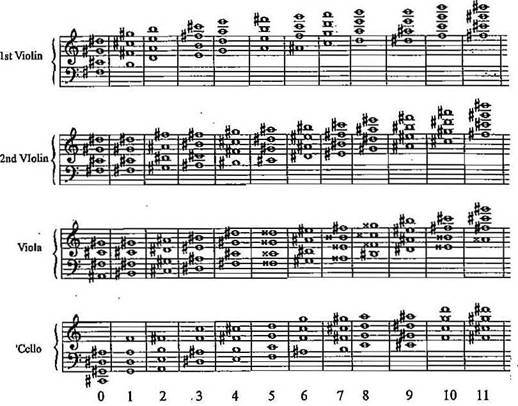
Example 9: Mr.
Bloomfield, His Spacing: Scordatura and Fingering Position Chart (Chart 1)
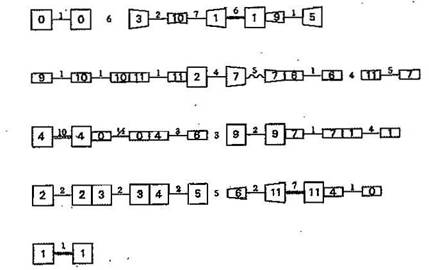
Example
10:
Mr. Bloomfield, His Spacing: Chart A
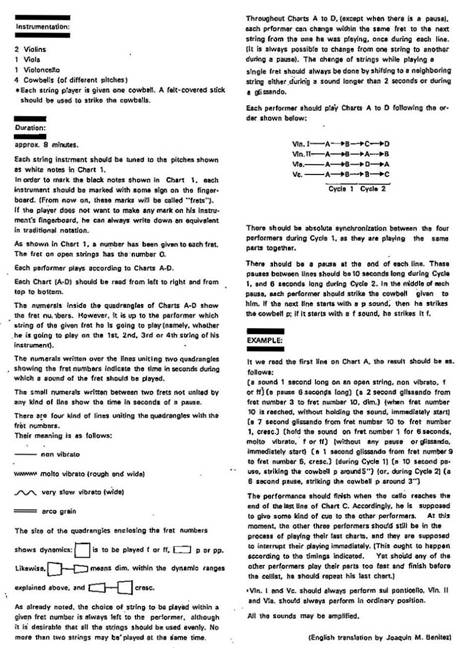
Example
11:
Mr. Bloomfield, His Spacing: Instructions
‘
The
use of rhythmic unison in Cycle 1 should be noted, as it is the first
appearance of a technique Kondo will employ in most of the sen no ongaku
works to follow. Rhythmic unison is used here to structure sounds not organized
in conventional harmonic or melodic groupings. From the listener’s point of
view, this aspect of the perception of things sounding together and things
sounding apart becomes very important in a work employing few recognizable
syntactic devices.
While
the jagged gestures, discontinuity and somewhat harsh sound world of Mr.
Bloomfield, His Spacing seem far removed from the lightly‑textured sen
no ongaku music it bears affinities with the new style in its definition
and limitation of musical elements, its simplification of material distinctive
formal clarity and most importantly, the first use of the rhythmic unison
technique which forms the backbone of virtually all works written in sen no
ongaku style.
Sen no ongaku Works: 1973 to 1980
To further aid the
discussion of sen no ongaku, the following six essential features of
this style are summarized as follows:
1. groupings of tones in order to
encourage multiple interpretations
2. vertical formations in no way
connected with functional harmony
3. non-teleological continuity
4.
single texture throughout a composition
5.
consistent use of asymmetrical rhythm throughout a composition
6. uni-sectional static form
It is important to
remember, that in spite of the development of sen no ongaku these six
features remain constant during the period 1973 – 1980. The flexibility of the sen no ongaku
style is revealed here in terms of how it is able to incorporate a wide range
of diversity while still adhering to these six principle features. We will
begin this examination of Kondo’s sen no ongaku style with a discussion
of melodic aspects. This is followed by an explanation of rhythm and meter and
vertical formations. Next, structure and form are treated, before concluding
with a discussion of mature works of the period.
In the
case of the works, Orient Orientation, Standing, and some other
compositions written up to 1975, the limitation of pitch content “was decided on
the basis of a chart of random numbers assigned to a gamut of sounds purposely
chosen beforehand.”
These gamuts of sounds, unique to each composition, are arranged in various
vertical and horizontal configurations, in an intuitive manner. The two gamuts
shown below very closely resemble serial pitch-sets, but they are in no way
treated as such, being merely the pitch material of the composition which is
organized using a combination of random and intuitive procedures (Example 12)
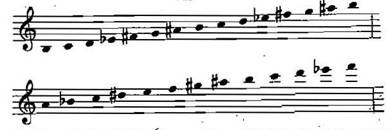
Example
12: Gamuts Used in the Composition of Orient
Orientation and Standing
In the
following example, the notes of the gamut “E” from Example 12 are arranged in a
line. This is the simplest form of arrangement of the notes of a gamut (Example
13).
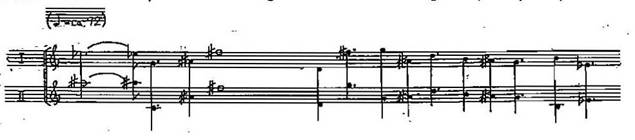
Example
13:
Orient Orientation: page 3, eighth system
The notes
of a gamut may also be combined in vertical aggregates as seen in Standing
(Example 14).
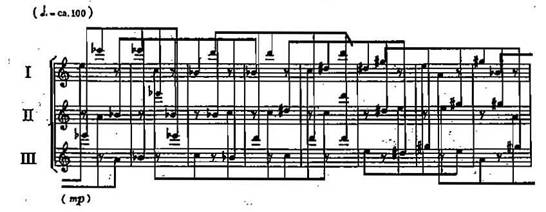
Example
14:
Vertical Configurations of Notes of the Gamut, Standing: page 13, third
system
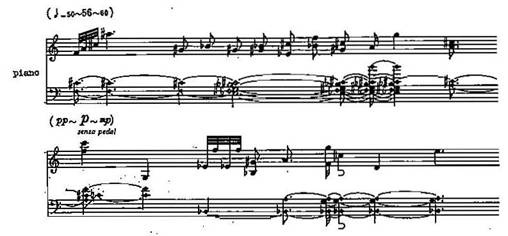
Example
15:
Click Crack: page 4, systems 5 and 6
Melodic
Style Categories
The five sen
no ongaku compositions on Kondo’s first record album are stylistically
quite contrasting works. While all are based on a single melodic line,
the specific treatment of this line varies quite radically from composition to
composition. The reader need only
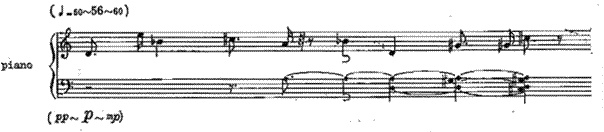
compare a few bars of the two works Standing (1973) (Example 16) and Falling
(1973) (Example 17) to recognize the range of this contrast. Here we have two
completely contrasting treatments of a line of tones, yet both conform to many
of the six features outlined at the beginning of this section. Comparing the various treatments of the
melodic note groupings in other works of the this period, equally striking
variations in style can be seen. To aid
comparison these variations are organized into three different stylistic
categories: simple melodic style, leaping melodic style and pointillist melodic
style.
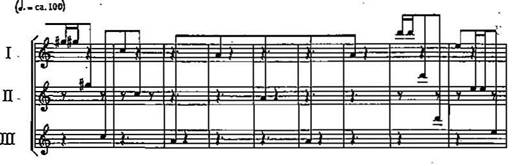
Example
16:
Standing: page 7, fourth system
Example
17:
Falling: page 7, first system
Simple Melodic
Style
The
clearly audible arrangement of tones seen in the first sen no ongaku
work Orient Orientation (1973) is representative of the
simple melodic style (Example 18).

Example
18:
Simple Melodic Style, Orient Orientation: page 4, fifth system
Another
example of simple melodic style is seen in Click Crack (1973) (Example
19).
Example
19:
Simple Melodic Style, Click Crack: page 9, first system
Leaping
Melodic Style
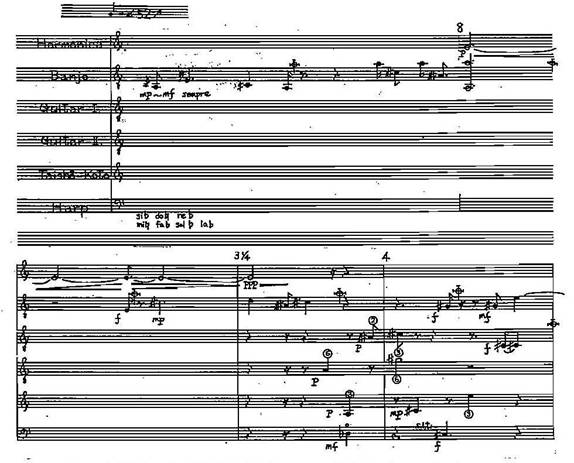
Leaping melodic
style lacks the smooth connection between pitches found in simple melodic style
due to the frequent occurrence of large melodic leaps (often greater than an
octave) and clearly audible breaks in continuity through the occasional use of
rests. A clear example of leaping melodic style can be seen in the banjo part
of the work Pass (1974) (Example 20).
Example
20:
Leaping Melodic Style, Pass: page 1, first and second systems
The
extreme melodic leaps throughout Retard (1978) for solo violin fracture
the continuity of the line to such a degree that the composition appears to be
written in three independent voices. Employing a technique very similar to that
found in Bach’s unaccompanied violin sonatas, Kondo fixes certain tones of the
gamut in one of three distinctive registers of the instrument (low range on G
string, middle range on the D and A strings and high range played in harmonics,
see Example 21).

Example
21:
Leaping Melodic Style, Retard: page 4, seventh system
As mentioned
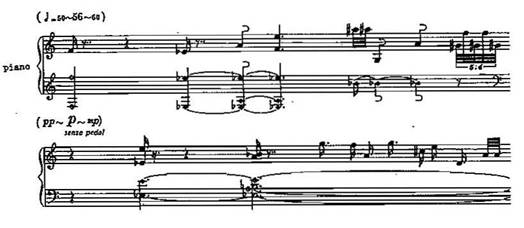
above in footnote 28, the line of tones of some sen no ongaku works may
fall under more than one category, as in the case of certain sections of Click
Crack. While this work for the most part is written in simple melodic
style, the leaping melodic style can also be seen (Example 22).
Example
22: Leaping
Melodic Style, Click Crack: page 8, first and second systems
This
excerpt is close to simple melodic style in terms of the connectedness of most of
the tones and the general contour of much of the quasi-melodic line. However,
the three rests in the first half of the first system and the leap from the
high A# to the low G, along with the repetitive leaping figure at the end of
the first system, fall more into the category of leaping style. A return to
simple melodic style occurs in the second half of the second system from the G
onward.
Pointillist
Melodic Style
A more
sophisticated melodic style involves the shifting of melody between various instruments
in a pointillist manner. Sight Rhythmics (1975), (both versions), Strands
I (1978), When Wind Blew (1979), An Elder’s Hocket (1979) and
An Insular Style (1980) are the six pieces of the period 1973 – 1980
which use this technique. The pointillist melodic effect in the ensemble
version of Sight Rhythmics is more prominent than the piano version due
to the shifting of the melody between instruments of sharply contrasting color
(Example 23). However, in the piano reduction of the work, in spite of the
relative homogeneity of the sound of the lines played by only one instrument,
the pointillist quality is still clearly audible. This is the first
introduction of pointillist piano writing which will recur in much of the
composer’s subsequent works for this instrument (Example 24).
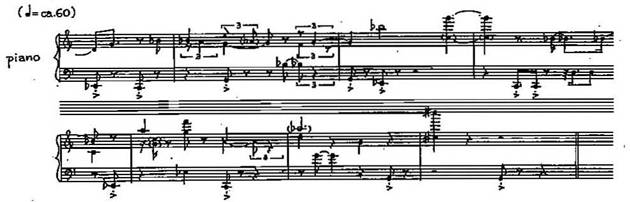
Example
24:
Pointillist Melodic Style, Sight Rhythmics (piano version): fourth
movement, page 4, sixth and seventh systems
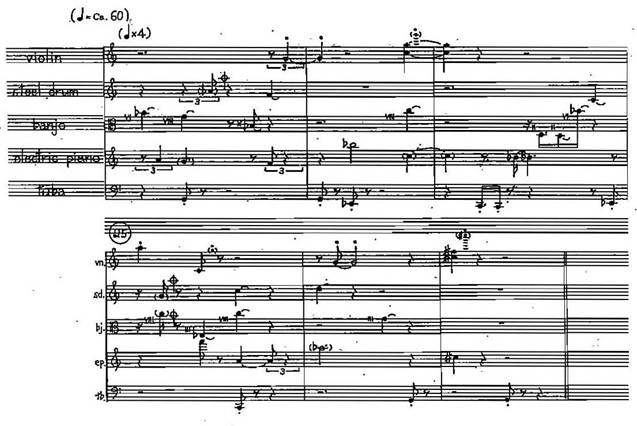
Example
23:
Pointillist Melodic Style, Sight Rhythmics: fourth movement, page 8,
measures 22 – 27
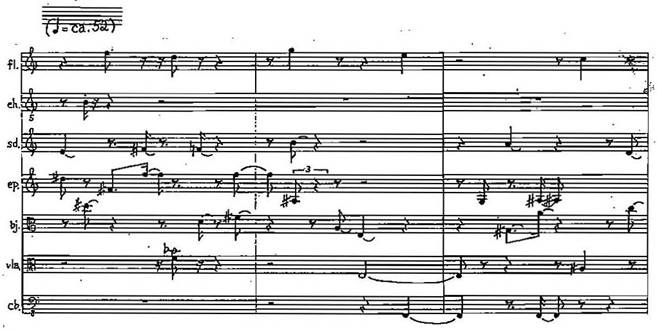
Example
25:
Pointillist Melodic Style, Strands I: page 4, second system
Strands I can be considered
a sister piece to the ensemble version of Sight Rhythmics due to the use
of three of the same rather unconventional instruments (steel drum, electric
piano and banjo), and its identical pointillist melodic style (Example 25). When
Wind Blew, written for a slightly larger ensemble, also employs pointillist
melodic style throughout the composition in the manner shown above (Example
26).
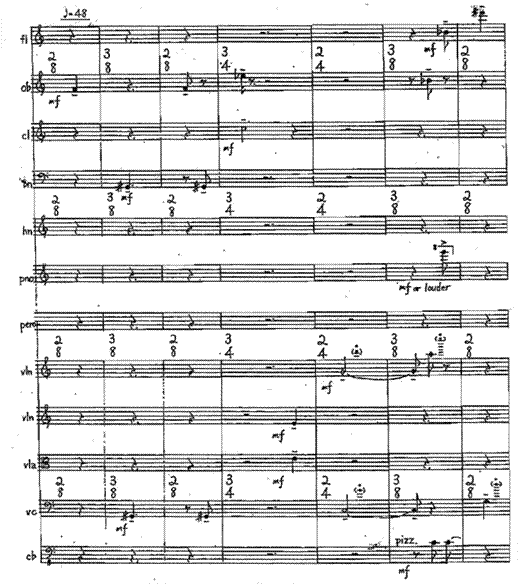
Example
26:
Pointillist Melodic Style, When Wind Blew:
page 2, measures 4 – 10
The
pointillist writing seen in An Insular Style is restricted to the
percussion and harp parts, with the upper two voices (flute and clarinet) being
written in a more conventional style (Example 27).
One of the
most important aspects of Kondo’s pointillist melodic style is how it
contributes to the autonomy of single tones. As can be seen in all the examples
above, single tones are clearly audible as single entities sounding alone in a
completely non-contrapuntal texture. Yet they are also connected to each other
in melodic groupings “which is precisely the syntactic device I [Kondo] use to
bind the individual sounds together.”
These examples above are representative of Kondo’s idea of the “melodic prism”
through which the listener perceives the individual sounds within a clear melodic context. The use of a pointillist melody-like
structure throughout a work encourages a more active form of listening to
individual sounds as the listener is never quite sure how, and in which voice,
the melody will proceed.
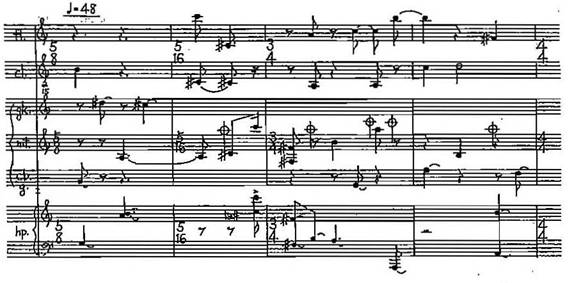
Example
27: Combination
of Pointillist and Simple Melodic Styles, An Insular Style: page 2,
measures 9 – 12
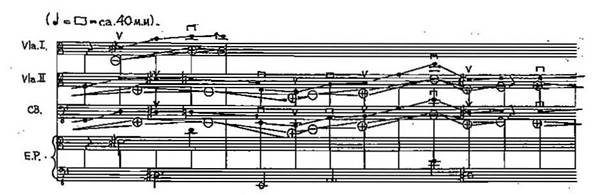
Example
28:
Falling: page 3, first system
In some sen
no ongaku compositions, the line on which the composition is based is
masked to varying degrees, making it somewhat difficult to assign it to any
specific melodic category. In the work Falling,
for example, the extremely elongated line played by the electric piano is
overshadowed by the more prominent glissando texture of the three string
instruments (Example 28).
In the
case of Pass, the banjo line while clearly audible, is also somewhat
obscured by the other four instruments which form a pointillist counterpoint to
this line. Example 29, which is representative of the work as a whole, is
heard more as a four-part texture than a single line with shadow notes. The
main line of the banjo is “almost buried” in the texture of the “independent
structure that could almost be called a figure for each instrument.”
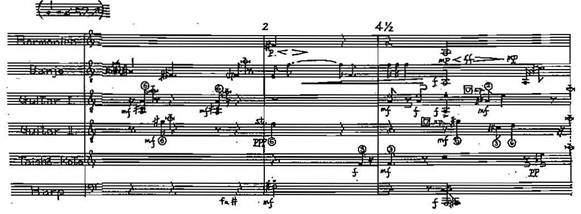
Example
29:
Pass: page 3, second system
In Threadbare
Unlimited, as a result of the dense harmonic texture, the original line
in the top voice is veiled to such an extent that it cannot be clearly heard at
all times (Example 30). In spite of the inaudibility of this line, we know from
Kondo’s words that the work is based on a single line as he explains it as his
“first timid attempt to apply somehow this kind of compositional methodology [Sen
no ongaku] to thicker materials.”
The work
An Insular Style is rather exceptional in Kondo’s oeuvre in that it is one of
the few compositions to employ conventional sounding melody which the composer
describes as “...more clearly articulated and less abstract than in most of my
works. Its melodic contour or phrase structure appears to be closer to
conventional melodic writing, and therefore more accessible to the listener.”
While the
melodic writing in this work most closely conforms to the stylistic category of
simple melodic style, it is somewhat different due to its very clear phrase
structure with definite points of cadential closure. In order to highlight the
difference between the quite similar simple melodic style and conventional
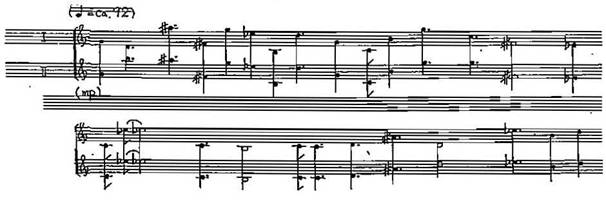
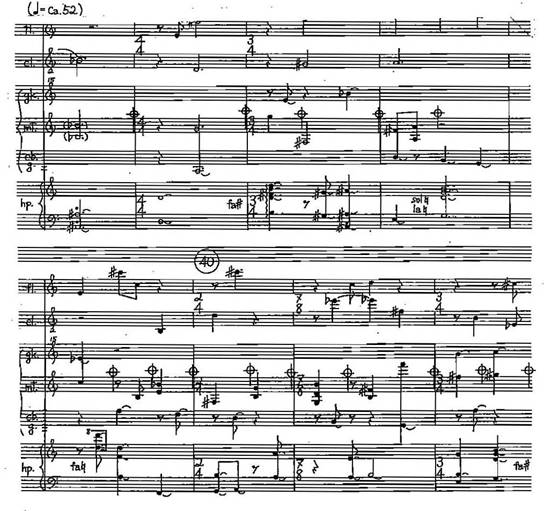
melodic style, an excerpt from Orient Orientation (Example 31) is
compared with an excerpt from An Insular Style (Example 32).
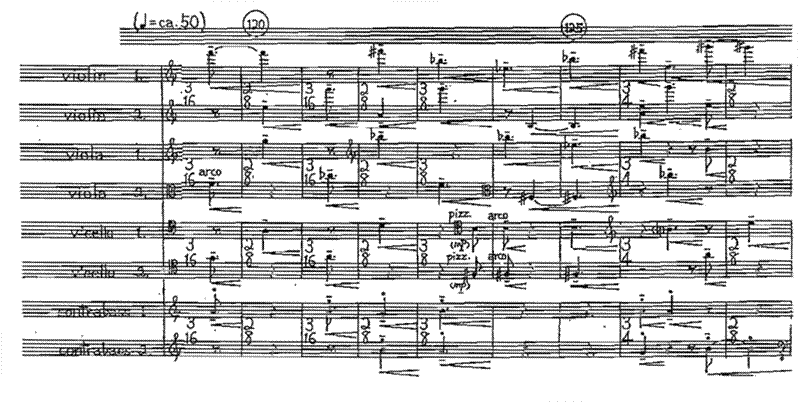
Example
30:
Threadbare Unlimited: page 9, measures 119 – 127
Example
31:
Orient Orientation: page 4, first and second systems
Example
32:
An Insular Style: page 4, measures 39 – 42
The melody
of Example 31 is continuous, with no clear breaks in phrasing. This melodic
fragment can be interpreted in various ways depending on how each individual
listener groups these notes into melodic figures. We could call this pseudo-melody. The flute
and clarinet lines in Example 32, however, strongly resemble conventional
melody as they are articulated in clear melodic phrases.
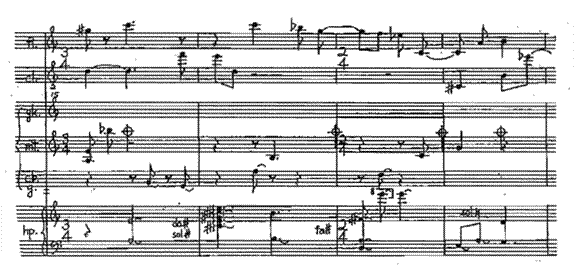
Looking at
another example from An Insular Style we can see that the melodic
figuration of the clarinet and flute are clearly independent from the
percussion and harp parts, which form an accompaniment to the two upper voices
(Example 33).
Example 33: An
Insular Style: page 3, measures 22 – 25
Example 33
clearly shows the dual function of the harp and percussion parts, on the one hand
as an accompaniment, and on the other hand as independent melodic figures. The
melodic aspect here is strengthened by the closeness of the melodic intervals. The
accompanying aspect is strengthened by the wide intervallic leaps and the use
of low pitches in the harp part. Occasionally, the harp and percussion writing
is strongly melodic, on almost equal footing with the upper two voices as in An Insular Style: page 4, measures 39 –
42 (see Example 32 above).
An Insular
Style is written in a subtle combination of pointillist and conventional
melodic styles with the harp and percussion relegated for the most part to an
accompanying role in pointillist melodic style. Conventional melodic style as
seen in this piece rarely surfaces in Kondo’s sen no ongaku music. When
it is employed, it is always combined with another melodic style.
Rhythm and
Meter
As we have
seen through the analysis of Orient Orientation, rhythm plays a very
important role in contributing to the autonomy of single tones. Asymmetrical
rhythm also creates the particular non-teleological, jagged continuity,
characteristic of all sen no ongaku works. However, this is not to say
that all of Kondo’s sen no ongaku compositions are written using
asymmetrical rhythm only. In some pieces, a very symmetrical rhythm is employed
in the form of a steady continuous pulse. These works share some affinities
with American minimalist music in their continual repetition of small cells of
pitch material over the entire composition, their relatively unchanging dynamic
texture, and their complete lack of sectional contrast and musical depth.
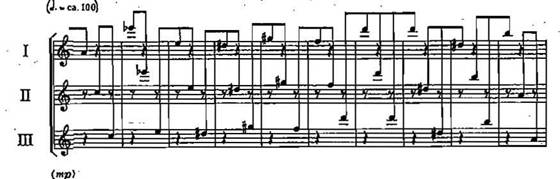
The three
works in the period 1973 to 1980 which conform to some minimalist
characteristics include Standing (1973) (Example 34), Luster Gave Her
the Hat and He and Ben Went On Across the Backyard (1975) (Example 35) and An
Elder’s Hocket (1979) (Example 36). In these three compositions, a
generally symmetrical rhythmic pulse is strongly prominent.
Example
34:
Standing: page 2, second system
Example 35
employs a single tempo, dynamic and texture throughout the composition. While
the eighth-note pulse is more or less constant throughout the entire work,
small sections are defined by slightly different rhythmic variations as can be
seen in the three systems of this example.
The
excerpt from An Elder’s Hocket (Example 36) is representative of
the work as a whole. As in the previous two examples, an eighth-note pulse is
clearly audible throughout the entire composition. The use of occasional
hemiola (the syncopated notes of the first beat of measure 71 and the last
beats of measures 87 and 89) adds some slight rhythmic variation at certain
points in the composition. But the use of this hemiola here, due to its
relative infrequency, has an ornamental function and does not shift attention
away from the steady eighth-note pulse.
Another
work employing a regular rhythmic pulse, which extends the technique of tied
note syncopation seen above even further is Walk for piano (1976)
(Example 38). Syncopation is used in Walk in a structural, rather than
ornamental manner. It is used so frequently in this work that the eighth-note
pulse is almost unrecognizable at times, with the rhythmic stress continually
shifting in an irregular manner over the course of the entire work.
In Example
37, within the space of only three systems, a great amount of rhythmic
variation can be found. The eighth-note pulse predominates in the first measure
of this example, but after entering the second measure, with the introduction
of the sixteenth-note on the second half of the second beat, the pulse is
interrupted. The eighth-note rest in the beginning of the third measure also
interrupts the eighth-note pulse. Syncopation is introduced again in measures
4, 5 and 6. The syncopation in bar 6 is very prominent due to its rather
extended duration of a dotted quarter-note. This extended duration has the
effect of almost terminating the sense of the eighth-note pulse.
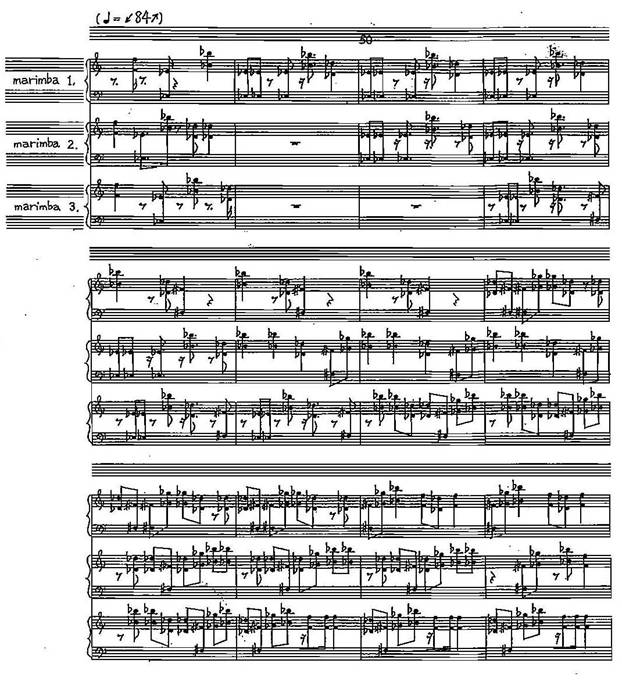
Example
35: Luster
Gave Her the Hat and He and Ben Went On Across the Backyard: page 5, measures
48 – 59
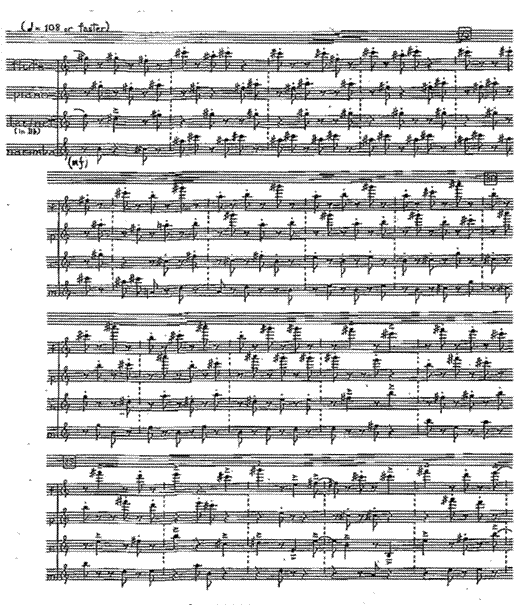
Example
36:
An Elder’s Hocket: page 5, measures 71 – 89
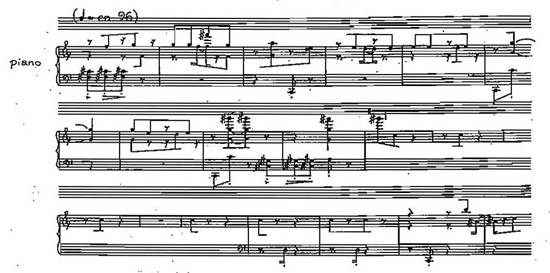
Example
37:
Walk (piano version): page 4, first, second and third systems
Another
interesting technique used by Kondo in this work to interrupt the continuity of
the eighth-note pulse is an instruction to stop suddenly in the middle of a
measure (see Example 38). It is the structural syncopation described above in
Example 37, along with the use of these fermata-like stop instructions shown in
Example 38, that set this work apart from the three works employing a more or
less steady pulse throughout the composition.
While the steady eighth-note pulses, although fragmented, are clearly
audible in Walk, the continuity of this composition is less periodic
than that of Standing, Luster Gave Her the Hat and He and Ben Went On
Across the Backyard and An Elder’s Hocket.
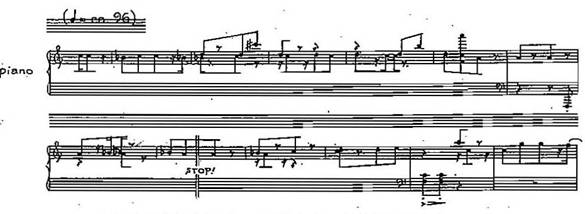
Example
38: Walk (piano version):
page 1, third and fourth systems
In spite
of the differences in style between Walk, Standing, Luster
Gave Her the Hat and He and Ben Went On Across the Backyard and An
Elder’s Hocket, all four works conform quite readily to five of the six
essential features of sen no ongaku style introduced on p.83 of this
study. Only one feature, the consistent
use of asymmetrical rhythm throughout a composition, does not apply to the
above four works.
In Standing,
Luster Gave Her the Hat and He and Ben Went On Across the Backyard and An
Elder’s Hocket, there are few explicitly recognizable rhythmic patterns. In
these three compositions written in uni-sectional static form, Kondo created a
dynamically and texturally uniform rhythmic field in order to experiment with a
new manner of listening that allows for multiple interpretations of rhythmic
groupings.
In the
case of music written in a single unchanging pulse, the only way groupings can
be perceived is through stress or emphasis of certain notes in relation to
others.
Kondo does in fact often employ stress at various points throughout the three
compositions above, but this stress is very irregularly placed creating
rhythmic ambiguity, which in turn, encourages multiple interpretations of
specific rhythmic groupings. Of the three works above, Standing treats
the link between rhythmic ambiguity and listening in the most sophisticated
manner. In this work, due to the delicate balance of various
asymmetrical rhythmic patterns, the listener is often at a loss as to where a
particular rhythmic pattern or melodic phrase begins or ends. The deliberately
ambiguous rhythmic groupings allow for a very rich listening experience in
which the listener is pleasantly disorientated throughout most of the work. Of
all the early sen no ongaku works, Standing most singularly
exemplifies the composer’s aesthetic intentions. This work was one of the last
to employ a pre-composed chart of random numbers assigned to a gamut of sounds
to decide the pitch content of the melodic line throughout the composition
(Example 39).

Example
39:
Gamut of Sounds Used for Standing
Due to the
biased distribution of sounds resulting from the random method of choosing his pitches,
an overall
quasi-modal (or ‘tonal’) flavor permeates the melodic line, since the biased
distribution of sounds emphasizes some specific pitches at the expense of
others, with the result that some of them almost sound like nuclear tones (or
even tonics) in a tonal composition.
After
generating the material of the work using random procedures, Kondo then deleted
any portion of the row which “was too obvious or too vague in its tonal feeling
so as to obtain the right degree of tonal ambiguity.”
It is important to note the composer’s decision here to combine a systematic
method of composing with an empirical one based on his own listening.
In the
beginning of the work from page one to the middle of the last system of page
three, the melody is distributed among the three voices employing the shadow technique
as seen in Example 40. From the last system of page 3 the texture becomes more
complex due to the overlapping of two rows creating harmony in the form of
two-note chords as seen below.
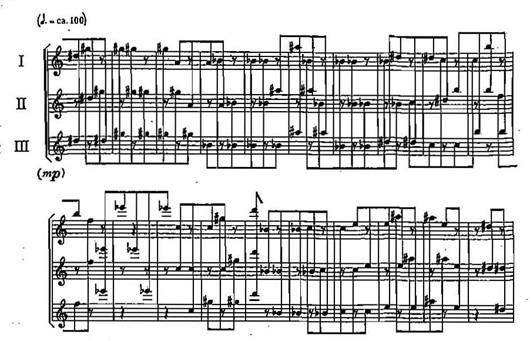
Example
40:
Two-Part Texture in Standing: page 4, first and second systems
Here in
the first system of Example 40, the pulse is just as metrically regular as Example
34, but the stress is less clear with the “feeling of triple time”
completely obliterated due to the very irregular groupings of tones into groups
of two, three or four repetitions of a single pitch. In the second and third
measures of the second system of this example, the insertion of a single
measure of material written in the same style as the earlier triple time
section serves to jog the listener’s memory by briefly re-establishing the
triple time grouping.
Another
rhythmic variation used in Standing to interrupt the continuity of the
eighth-note pulse is shown in Example 41. Here, from the third to the seventh
measure, a change in tempo is achieved by inserting rests between notes. The
separation of the notes by quarter-note rests stresses the feeling of triple
time.
A very
brief tempo change in the first three bars of Example 42 is achieved by the
insertion of eighth-note silences between the sounding pitches. In this case, a
duple time feeling is created.
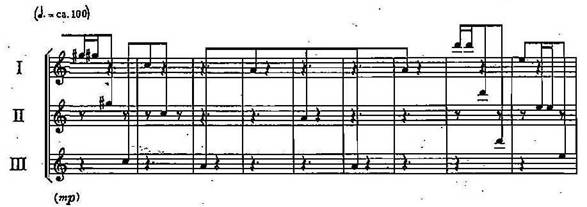
Example
41: Tempo
Shifting Through the Insertion of Rests in Standing: page 7, fourth system
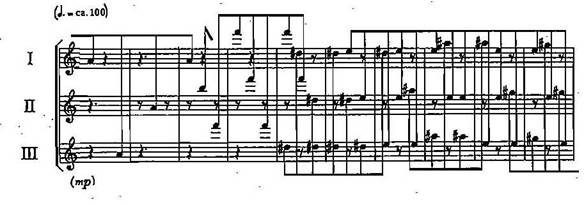
Example
42:
Tempo Shifting Through the Insertion of Rests in Standing: page 5, third system
Another form
of variation by rhythmic diminution (from eighth-note to sixteenth- note pulses) appears in an extended section
of the work from the fourth system of page 15 to the third system of page 18. An
example of this texture is shown in Example 43.
Looking at
the placement of these sixteenth-note figures over the whole example, we can
see that in the first system, the sixteenth-note figures are placed in an
asymmetrical manner. In the second and third systems however, they are placed
in a symmetrical manner in order to emphasize the feeling of triple time.
Rhythmic ambiguity in Standing is achieved through the horizontal and
vertical juxtaposition of these small rhythmic cells of various durations.
It is this
balance between regularity and irregularity, an idiosyncrasy of all sen no
ongaku works to follow, that gives this composition its essential musical
shape and characteristic jagged continuity. Kondo’s primary intention here is
to create a musical environment which leaves the listener “enough leeway to
decide the groupings by himself”
to allow for an interpretation of the groupings different from the way the
composer might hear them.
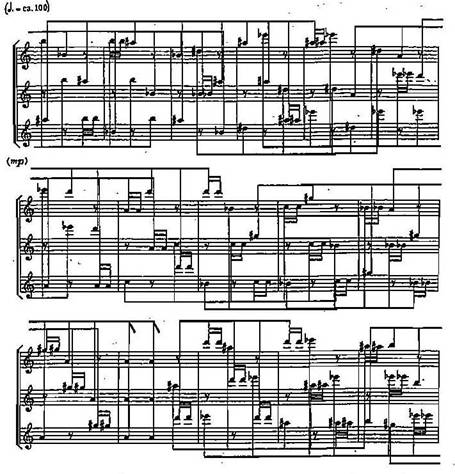
Example
43:
Rhythmic Diminution in Standing: page 17, first, second and third
systems
A New
Rhythmic Notation
In 1973
with the composition of Click Crack (1975) Kondo introduced a new
rhythmic notation (Example 44) to express a non-bipartite value in a clear
manner. This notation first appears in Click
Crack.
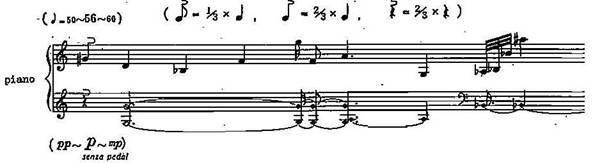
Example
44: Rhythmic
Notation and Usage in Click Crack: page 1, second system
In conventional
notation, the above expressions of one third or two thirds of a beat or rest
can only be accomplished by using the closest rhythmic value in a symbolic
manner. Kondo’s new notation is very
close to an earlier example of a new notation created by Henry Cowell to
reflect irregular note values. Cowell explains his new notation in the
following manner:
Still
another possibility opened up by the new notation is that of separating notes
of triplet or other time values by placing between them notes of other
systems. Thus in old notation three
triplet notes or their equivalent must always be used together; in the new
notation perhaps only one triplet note will be used between quarter notes,
While Cowell’s
1/3 note in the above example does not have complete independence in the same
manner as Kondo’s notation, Cowell’s quote seems to suggest that he was aware
of the possibility of the complete independence of such a figure in the future.
In the period
1973 – 1980, the following works use Kondo’s new notation: Click Crack
(1973), Pass (1974), Sight Rhythmics (both versions) (1975), Retard
(1978), Strands I (1978) and Strands II (1980). Although this notation was not used in works
written for large ensembles up to 1980, after this date, with the move towards
complexity, we can find this rhythmic notation used in a much more intricate
context in Res sonorae (1987) (Example 45).
Circles in
Example 45 are dynamic indications written by the composer. The use of the new
rhythmic figure occurs in measures 35 and 38.
In general Kondo restricts the use of this notation to chamber works of
two to five instruments, but here it is used very effectively in an ensemble of
fourteen players.
Vertical Formations
With the
exception of The Shape Follows Its Shadow (1975), Threadbare
Unlimited (1979) and A Shape of Time (1980), vertical formations in the
works written in the period 1973 -1980 generally consist of two-note chords. These
two-note chords have no relation to functional harmony and can be considered as
simply colorings of single tones. These
harmonic colorings (explained in detail in the analysis of Orient
Orientation in Appendix A) occasionally expand to three-note chords as seen
in Knots (1977) (Example 46). The consistent use of rhythmic unison in
this excerpt, helps to maintain a balance between linear and harmonic elements.
In the case
of Click Crack, vertical formations of four or more notes are written in
the form of the barely audible piano harmonics (Example 47).
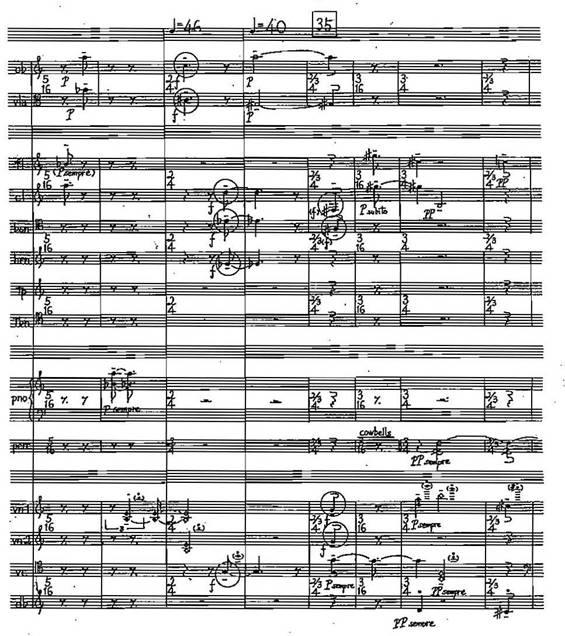
Example
45:
Res sonorae, page 5, measures 31 – 38
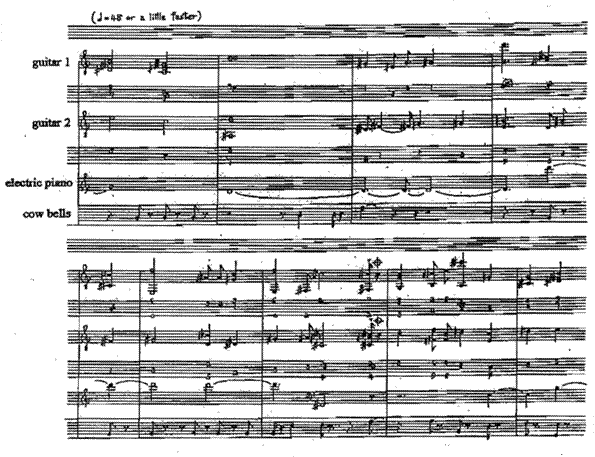
Example
46:
Knots: page 7, first and second systems
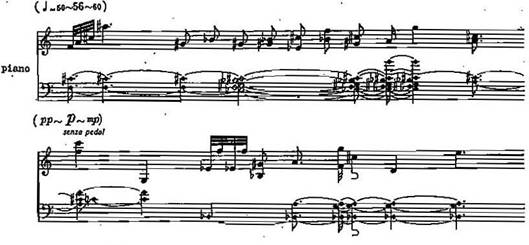
Example
47:
Click Crack: page 4, fifth and sixth systems
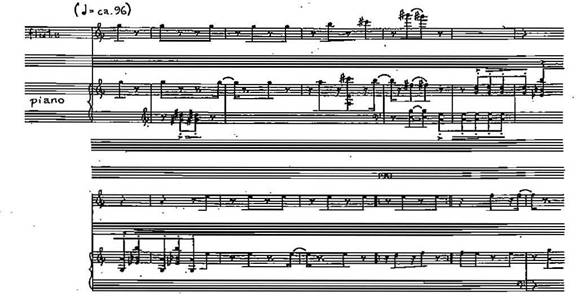
Vertical formations
sometimes appear suddenly for slight textural contrast as seen in the work Walk
for flute and piano (Example 48).
Example
48:
Walk: (flute and piano version) page 8, first and second systems
Chords in Walk
are treated in the same way as single pitches, appearing in a hocket-like
manner to emphasize the linear movement of the eighth-note pulse. Any potential connections to functional harmony
are considerably weakened by this clear emphasis of rhythmic over harmonic
relations.
The use of
particular intervals throughout a single work, determines to some extent, the
atmosphere of each of Kondo’s compositions. In general, most of the intervals
making up the harmonies used in the works composed form 1973 to 1980, are consonant
or mildly dissonant. Preferred intervals include: the major second, minor and
major thirds and the perfect fourth and fifth. Vertical formations made up of
three, four or more notes are also employed in the works The Shape Follows
Its Shadow, Walk, An Insular Style and A Shape of Time. The
consistent use of relatively consonant intervals and chords contributes to the
diatonic or modal sounding atmosphere of the works composed in this period. From
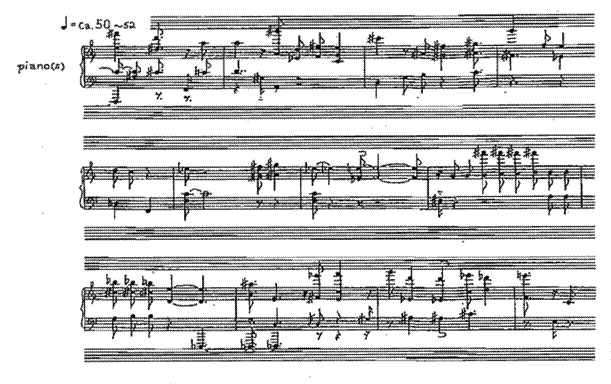
the composition of Strands II at the end of 1980, the preferred
intervals are much more dissonant, with minor seconds, major sevenths and minor
ninths replacing the more consonant intervals of the earlier period (Example 49).
This
discussion of vertical relations will close with a discussion of An Insular
Style, a piece which in the composer’s words is “rather exceptional in this
linear style of mine,”
due to the use of conventional melodic writing and tonal harmony. Continuing he
states: “Harmony, although not supporting the melody line in a traditional
sense, but just ‘shadowing’ that line to give it some coloring, is more unambiguously
tonal than usual. Altogether, An Insular Style may sound much like a
folk tune from an (imaginary) island.”
Example
49:
Strands II: page 7, third, fourth and fifth systems
Two
factors contribute to the “unambiguously tonal” sound world in this work. These
are conventional melodic writing in the upper two voices and the use of particular
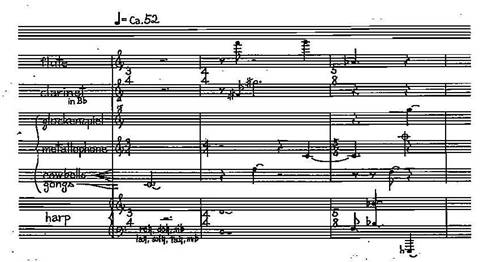
consonant intervals. One rather traditional aspect of this composition not
found in earlier sen no ongaku works is the assigning of specific
functions to the four instruments, with the flute and clarinet playing
melodies, and the harp and percussion assigned to an accompanying role for the
most part (Example 50). Here the harp has the clearest accompanying role by
playing chords and single pitches in its lower range. The accompanying role of
the percussionist is not felt as strongly as the harp’s, because the chords are
played simultaneously on two instruments of very contrasting timbres. The
indefinite pitch of the cowbells also weakens somewhat, the sounding of clear
harmonies. Compared to the harp, which has the specific role of grounding the
harmony, the percussion accompaniment has a more coloristic role.
Example
50:
An Insular Style: page 10, measures 110 – 114
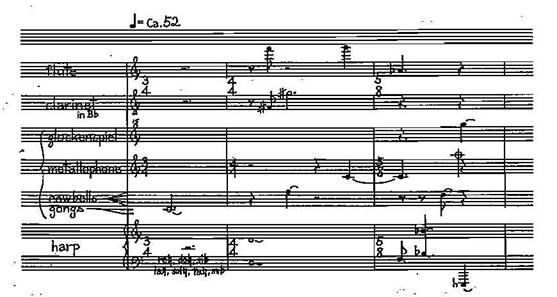
Tonal harmony is strongly suggested
by the frequent use of consonant intervals and triadic harmony throughout the
composition (Example 51).
Example
51:
An Insular Style: page 1, measures 1 – 3
The third measure
of Example 51 serves as a clear example of how tonality is emphasized through
instrumental range and particular choice of intervals. The tonal harmony is
reinforced by the range of the harp, with the low E flat (functioning here as a
tonic), being played in combination with a very high G (3rd) in the
glockenspiel part. The harmony here is strengthened even more as the preceding
B flat and F in the harp part (which resonate through the entire bar) complete
an E flat chord.
The
occasional use of arpeggios in the harp part also strengthens the
harmony by drawing attention to the quasi-tonal chordal formations played
(Example 52).
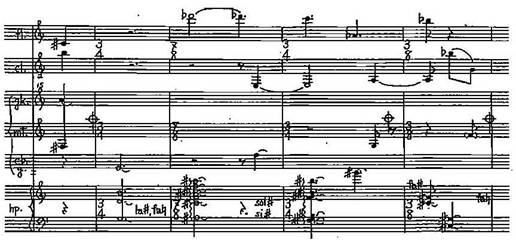
Example
52:
An Insular Style: page 7, second half of measures 71 – 75
While this
work employs very tonal materials, it must be remembered that they cannot be
classified in terms of functional tonality.
In spite of the rather conventional melodic writing in the upper two
voices, the melodic notes for the most part align rhythmically with other
voices creating what the composer refers to as “the linear character of many of
my compositions, written almost entirely as a single, continuous melodic line,
accompanied by some harmonic coloring of the notes that make the main line.” While the principles of sen no
ongaku are still clearly adhered to, a new melodic freedom and emphasis on
tonal harmonies can be found in this somewhat atypical composition.
Structure
and Form
The single
most important aspect of Kondo’s style, namely, its linearity, has been treated
in detail up to now. While almost all of
Kondo’s compositions from 1973 to the present can be said to be “consistently
centered on ‘static form’¼ and on
the concept of ‘linear music,’ music consisting of a single ‘melodic’ line,”
there are other elements of the style not yet addressed, which will be taken up
in this section. We will now widen our
lens to view the works in terms of their larger structures and overall form.
Most
compositions of the first period are written in uni-sectional static form. That
is to say, most works consist of one continuous, relatively uniform stream of
music, with little textural, harmonic and dynamic contrast. These works are:
Orient Orientation (1973), Standing (1973), Falling (1973), Click
Crack (1973), Pass (1974), The Shape Follows Its Shadow (1975),
Luster Gave Her the Hat and He and Ben Went Across the Backyard (1975), Walk
(both versions) (1976), Knots (1977), Retard (1977), Strands I
(1978), A Crow (1978), An Elder’s Hocket (1979), When Wind
Blew (1979), Threadbare Unlimited (1979), An Insular Style
(1980), A Shape of Time (1980) and Strands II (1980).
A few
works from the period 1973 to 1980 are structured in distinct contrasting
sections and therefore fall outside the category of uni-sectional static form. They
include: Mr. Bloomfield, His Spacing (1973), Wait (1973)
and Under the Umbrella (1976).
Sight
Rhythmics
One very
important work in Kondo’s oeuvre which hovers between the two formal categories
of uni-sectional static form and sectional form discussed above is Sight
Rhythmics (1975). This work is one of the few sen no ongaku
compositions involving separate movements. However, because these movements are
almost identical to each other, with very slight changes from movement to
movement, there is little sense of development over the course of the work. The
composition can almost be likened to a single stream of music with rests
inserted to occasionally break the continuity, in the same manner as Orient
Orientation (see Appendix A). We know from reading Kondo’s words that this
work was an important turning point in terms of how he treated form and larger
structural divisions: “It was from Sight Rhythmics that I consciously
started to search for ambiguities on the structural level that might
traditionally be called form.”
One of the
distinguishing features of the ensemble version of Sight Rhythmics (for violin,
steel drum, banjo, electric piano and tuba) is its unorthodox instrumentation. The
distinctive instrumentation of five completely dissimilar instruments was
chosen to emphasize individual sounds, as the timbres of these five instruments
do not blend so easily. Looking at the first seven measures we can see that
this work is written in pointillist melodic style with no real individual voice
independence (Example 53). Looking carefully, it can be seen that in spite of
the occasional overlapping of voices, for the most part, the texture consists
of a single line played in a hocket-like manner by each instrument in
succession. Due to the relatively close spacing of the notes of this line
(apart from the very low notes in the tuba and very high notes in the violin)
it can be quite readily distinguished by the ear.
The
individual voices of each instrument cannot be said to form continuous lines in
the manner of a clear instrumental part because of the continual breaks in
continuity. However, due to the extremely distinctive timbre of the
instruments, the ear has little difficulty in following each instrumental
voice. In the example below the tuba notes are the most obviously audible,
forming a kind of bass accompaniment to the upper voices. The violin voice is
also clearly audible due to the high range of the harmonics and the restriction
to only two pitches, like the tuba. The steel drum and banjo parts tend to
overshadow the electric piano voice, but if one chooses to focus attention on
the electric piano only, most of this part is also clearly audible due to the
frequent sounding of notes in complete isolation.
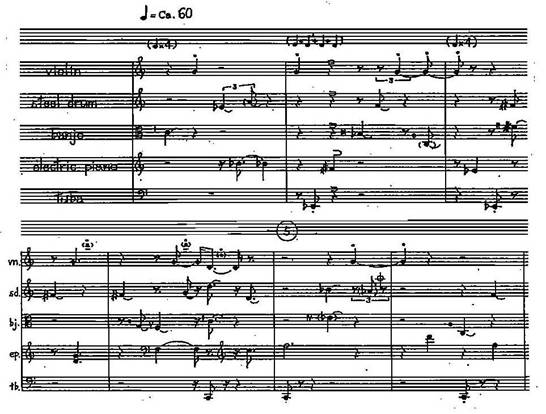
Example
53: Sight
Rhythmics:
movement 1, page 1, measures 1 - 6
Melodic
structure in Sight Rhythmics is rather ambiguously implied in order to
suggest multiple readings. When listening to this work the ear tends to
vacillate between various points of focus. The listener might follow the flow
of the melody from instrument to instrument for a few bars and then later be
drawn to a distinctive pattern (or pulse in the case of the tuba and violin
parts) in a single instrumental voice. As in all sen no ongaku works of
this period, note groupings are not explicitly expressed, allowing for various
interpretations depending on the predilection of the individual listeners.
Kondo explains this ambiguous application of note groupings in Sight
Rhythmics in the following manner:
¼ there is a
melody-like structure, but it is never unambiguously established; it is almost
a melody, yet not quite. The listener
can feel that a melody-like structure exists (which is precisely the syntactic
device I use to bind the individual sounds together), but he is still able to
recognize each individual sound in its own right.
When
composing this work, Kondo was interested in touching on a particular problem
inherent in ensemble playing, in which performers are required to play
individual parts (which are incomplete by themselves) in a collective manner to
realize the whole. Kondo used the Japanese term “sanso” (literally,
scattered playing) to describe this performance practice.
This term relates to one of Kondo’s most important aesthetic concerns, namely,
“that in music each sound has to have its own entity and life.”
Sight
Rhythmics
is divided into six movements. The first five movements are of exactly equal
length and sound almost identical. The final movement, as the subtitle
“SCHOLION” suggests, functions as a kind of appendix to the work. However,
because the texture, pitch material and hocket-like phrasing of this final
movement are almost identical to the preceding five movements, it acts as a
very subtle closing to the work.
Because of
the very slight alteration of material in the first five movements of Sight
Rhythmics (only one instrumental part changes from movement to movement)
there is a clear lack of development but a definite sense of change over time,
although it is somewhat difficult for the listener to pinpoint concretely where
this change occurs. Kondo termed this
very subtle change from movement to movement “pseudo-repetition” which “is
almost as static as literal repetition, but at the same time becomes a vehicle
for hidden change and movement.”
The
movement to movement changes in Sight Rhythmics are shown in the
following chart in Example 54. The capital letter A signifies original
material, B signifies alteration of the original material, and C signifies
completely new material. Lower case letters correspond to the first letters of
the names of the five instruments.
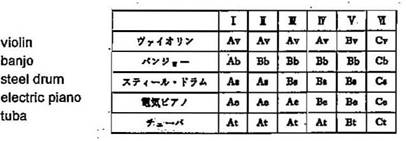
It can be seen
from looking at this chart that once a part changes it remains fixed in that state
until the final movement. Changes in this work are cumulative occurring gradually
from movement to movement Rather than
development, we can liken this to a very subtle organic growth. Kondo uses the
term “dynamic stasis” to describe this form of continuity and perception of
time: “We could liken the listener’s experience of dynamic stasis to the way we
experience our everyday life. Each day seems very similar to the previous one
(daily routine), but today is never exactly the same as yesterday.”
Viewing
the work closely it can be seen that when parts change they are altered in a
very subtle manner with the altered line closely resembling and occasionally
duplicating the line of the previous movement. We can see the result of the
cumulative change over the course of the entire work by comparing the opening
measures of the first movement to the corresponding measures of the fifth
movement (Examples 53 and 55).
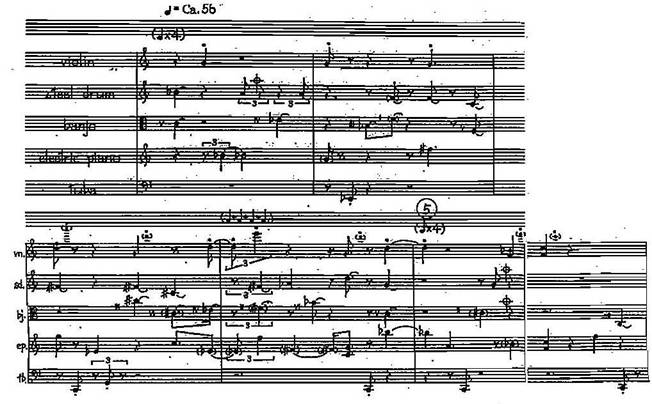
Example
55: Sight
Rhythmics:
fifth movement, page 11, measures 1 - 6
The
composition of Sight Rhythmics marks a very important transition from
early to mature sen no ongaku . It is here that the composer first
grappled consciously with problems of form.
In this work Kondo was interested in organizing material in distinctive
movements, to experiment with pseudo-repetition and dynamic stasis. For the
first time since 1973, the steady stream, uni-sectional static form of almost
all of the sen no ongaku works written up to this point, is abandoned in
favor of a new means of organizing the material of a single work in self-
contained movements thus broadening Kondo’s palette of structural and formal
devices.
While
there are no recurrences of “pseudo-repetition” using completely symmetrical
self-contained movements in future works, slightly different forms of
“pseudo-repetition” can still be found. Viewed in retrospect, we can see that Sight
Rhythmics was a kind of laboratory for Kondo to experiment with techniques
of “pseudo-repetition,” which could easily be transferred to works of larger
forces.
Under the
Umbrella
Under the
Umbrella
(1972) is a unique composition in Kondo’s oeuvre as it is the only work in
which the sen no ongaku method is applied solely to instruments of
non-standardized pitch.
The work is written for five performers, each playing five cowbells, with the
first performer also playing a low gong only at the end of the piece. Kondo specifies in the instrumentation of the
work that “25 graduated cowbells” are to be distributed equally among the five
performers in ascending order from the lowest to the highest sound in the
following manner: The first player: numbers 1, 6, 11, 16, 21 and a low gong;
the second player: numbers 2, 7, 12, 17, 22; the third player: numbers 3, 8,
13, 18, 23; the fourth player: numbers 4, 9, 14, 19, 24; the fifth player:
numbers 5, 10, 15, 20 and 25. This particular distribution was decided in
order to facilitate the rapid playing of adjacent pitches among all members of
the ensemble which would be otherwise be impossible for one player to execute.
The very
uniform sound world of Under the Umbrella represents a strong shift away
from the sound world of almost all previous sen no ongaku works. This work is written in four movements of
contrasting character which gives strong formal coherence to the composition.
The specific character of each of the four movements is created by variations in
tempo, texture and dynamics. This character is sustained throughout each
movement by being written in uni-sectional static form.
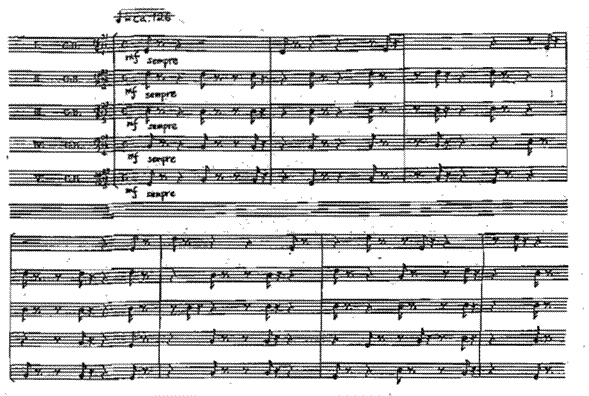
The first
movement, written in the quick tempo of q =126, is
characterized by the use of a driving
eighth-note pulse with frequent syncopation alternating between various
densities of vertical aggregates, from single pitches to five-note vertical
aggregates, as seen in Example 56.
Interestingly,
the rather sparse-looking score does not reflect the rich musical effect of the
rapid playing of the 25 graduated cowbells.
Although the cowbells are not fixed in standard pitches, the ear still
tends to group notes into melodic patterns in the same manner as other sen
no ongaku works of this period. That is to say that there is a very strong
sense of linkage from pitch to pitch. Other important aspects of sen no
ongaku style in works composed from 1973 to 1980 can also be found in this
movement. First, there is no dynamic contrast, with the entire movement being
played mezzo forte. Second, all
vertical aggregates are aligned in rhythmic unison with a clear absence of a
contrapuntal texture. Third, and most important, the music is written in a
continuous stream, without goal oriented movement or cadential closure.
Example
56:
Under the Umbrella: Beginning of Movement 1, page 1, first and second
systems
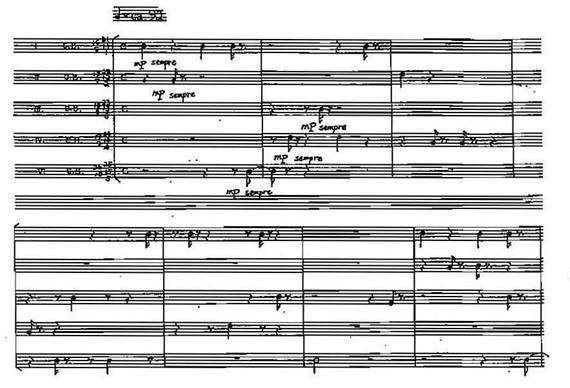
The second
movement bears close resemblance to the first in terms of its employment of
similar texture, but with some important differences. The slower tempo of q =
92 helps to contribute to the sounding
of each pitch or pitch aggregate as an isolated event rather than` a pulse, as
in the much faster first movement. The very sparse texture of this second
movement also allows the listener to focus on the timbre of each cowbell much
more clearly than the first movement. Combinations of cowbells here serve to
punctuate the quasi-melodic line played by single cowbells (Example 57).
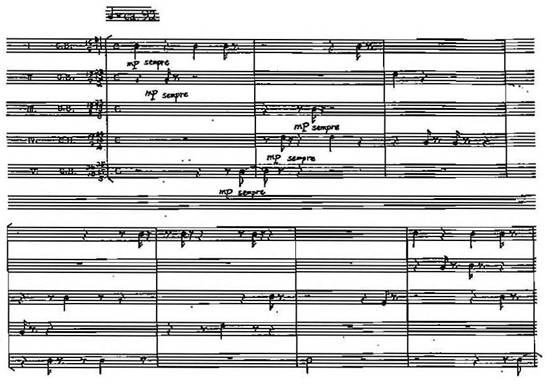
In the
context of the work as a whole, the third movement is somewhat anomalous. It is most clearly distinguished from the
other three movements by the use of continuous tremolo playing with occasional fortissimo
attacks as seen in Example 58.
While the
first, second and fourth movements clearly fall under the category of sen no
ongaku style, the third, due to its frequent breaks in continuity, use of
sections written in a quasi-contrapuntal texture, and block-like construction,
falls out of the category of first period sen no ongaku compositions. We
can see in Example 58 a great amount of change from measure to measure which
contrasts sharply with the uni-sectional static form of the other three
movements. Here within the space of only twelve measures, there is a great
contrast in dynamics and articulation, along with clear breaks in the texture
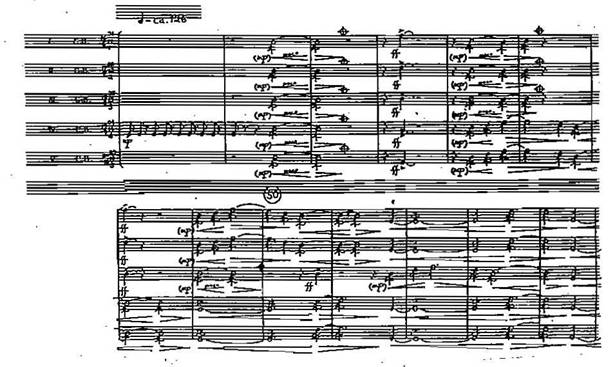
which tends to fracture the continuity. In Example 59, also taken from the
third movement, we see a combination of textures very foreign to the sen no
ongaku style in the form of a short rhythmic figure played by the fourth
player followed by a rich vertical aggregate played by the full ensemble. This
kind of sharp contrast between measures of material of very different rhythmic
character is rarely found in the sen no ongaku works written between
1973 and 1980. It occurs only occasionally in much later compositions written
after 1987.
Example
57:
Under the Umbrella: Beginning of Movement 2, page 8, third and fourth
systems
Example
58:
Under the Umbrella: Beginning of Movement 3, page 13, first and second
systems
Example
59:
Under the Umbrella: Movement 3, page 14, third and fourth systems
The fourth and final movement of the work is written
in the fastest tempo of q = 152. The general
character of this movement bears strong resemblance to the first movement in
terms of its quick tempo, similar texture and the frequent employment of
syncopation alternating between various densities of vertical aggregates. Due
to its rather short duration in relation to the other three movements, and its
close similarity to the first, it almost functions as a kind of recapitulation
(Example 60).
One
important aspect all movements share, regardless of their quite contrasting
character, is the more or less consistent use of rhythmic unison. Rhythmic
unison here has the extremely important function of linking sound events of
similar timbre but non-standardized pitch. In the first, second and forth
movements, the rhythmic unison writing consists of rather short punctuations in
marked contrast to the long sustained tremolos of the third movement.
There is a certain logic
behind Kondo’s decision to write for the rather unusual ensemble of 25 cowbells
of graduated pitch. Had he opted to write for different non-pitched percussion
instruments, one of the composer’s most important concerns - that of preserving
the specific relationships between tones – would be lost. Because the cowbell
pitches are not standardized, we cannot speak of the relationships between them
in the same manner as standardized fixed tones, but they are nonetheless
clearly distinguishable from each other with each cowbell having a particular
identity, being of slightly different pitch and timbre. These 25 different
sounds are essentially equivalent to the composer’s gamuts employed in his
earlier works. Thus while there are almost twice as many tones used in Under
the Umbrella than the tones used for Orient Orientation (15 tones)
or Standing (12 tones), they are organized in essentially the same
manner, that is to say, all pitches are of equal importance with no particular
emphasis on any one as a central tone.
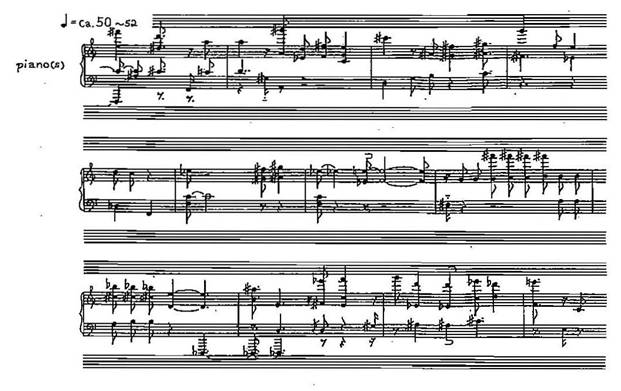
Example
60: Under
the Umbrella: Beginning of Movement 4, page 21, first and second
systems
Under the
Umbrella
is another extremely important work for Kondo as it afforded proof that the
principles of sen no ongaku could apply equally to standardized and
non-standardized pitched instruments. In this work Kondo was able to preserve
the relationships between pitches, but organize them in a non-hierarchical
manner with no relations to functional harmony or conventional melodic writing.
Sen no
ongaku,
Mature Works: 1978 to 1980
By 1978
Kondo had refined certain aspects of his his sen no ongaku style. With
the composition of Strands I (1978) the stark, uniform stream of music
is transformed into a texture with a more sophisticated balance of linear and
harmonic elements. This can be seen in the works When Wind Blew (1979), Threadbare
Unlimited (1979) An Insular Style (1980), A Shape of Time
(1980) and Strands II (1980).
In these
six works the hocket-technique first encountered in Orient Orientation
is more refined with the shifting back and forth between a greater number of
voices. The asymmetrical rhythmic writing sounds more self-assured, and less
mechanically derived, perhaps as a result of the composer’s decision to abandon
pre-compositional devices such as use of pre-compositional gamuts in the determination
of the overall form. According to Kondo the “actual structure and duration of
the piece just comes out as a final result of a process based on my ‘listening
experience’. This process does not involve any kind of formalistic approach. It
is thoroughly empirical.”
The
compositions after 1978 are subtly organized with musical events having the
sense of being more delicately placed in time than the earlier works based on
gamuts. With the exception of Strands II, all the ensembles are larger
and Kondo is now focusing on details of orchestration, in particular, with the
problem of how to thicken the line with a richer texture.
We will explore the refinements of sen no ongaku of the late 1970’s
through the examination of the two works Strands I (1978) and When
Wind Blew (1979).
Strands I
Due to the
very strong resemblance between Strands I and Sight Rhythmics
these two works can be considered sister compositions. Similarities to Sight Rhythmics which
can be clearly seen in Example 61 include the use of unconventional
instrumentation of roughly the same number of instruments, a very sparse and
uniform pointillist texture, and the employment of ambiguous phrasing which
contributes to the autonomy of single tones.
Strands I is different from Sight
Rhythmics in one essential aspect The former work is a uni-sectional
composition written in a continuous stream, while the latter work is written in
self-contained independent movements. The texture of the example above
continues throughout the entire work, with an occasional thinning out when the
number of instruments playing is reduced. If we compare Strands I to the
earlier work Pass (1974) (Example 62) we can see how the sen no
ongaku style has developed over a period of three years.
Looking
at this excerpt from Pass we can see that the individual lines are
relatively independent, with relations between parts much less controlled than
in Strands I. Due to the tight control of relations between all seven
parts of Strands I, the delicate balance of musical events being played
in and out of rhythmic unison is clearly audible. The relations between parts
in Pass, however, are not as controlled with the result that the
rhythmic pacing of the piece sounds a little more haphazard and less refined.
While both works use very irregular meters, the subtlety of the rhythm is more
discernable in Strands I because there is less counterpoint and little
dynamic contrast between instruments with all instruments sharing the same
dynamic range from mezzo piano – mezzo forte. Sudden shifts in
dynamics in Pass
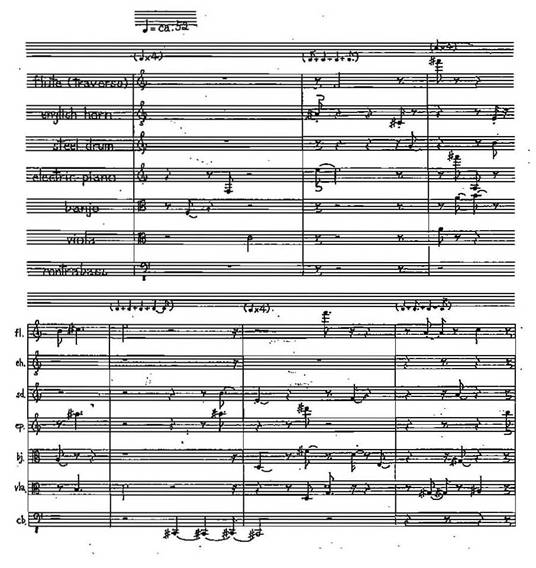
Example
61: Strands
I:
page 1, measures 1 - 6
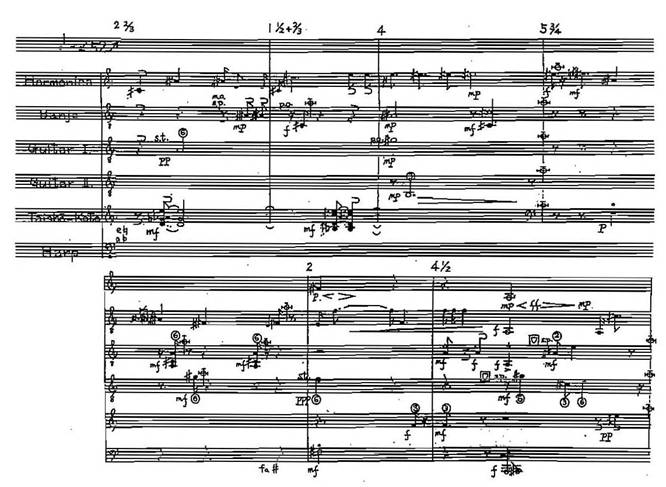
Example 62: Pass:
page 3, first and second systems
When Wind
Blew
A composition
for a slightly larger ensemble than the previously treated works, which
displays a definite refinement of sen no onagku, is When Wind Blew
(1979). Kondo mentions that the composition of When Wind Blew and An
Elder’s Hocket was one of his first attempts to apply the sen no ongaku
style “to ensembles of more conventional instrumental combinations.”
In this work the hocket-like style is more refined than in earlier
compositions. This refinement lies in the keen attention to details of
instrumentation through pitch doublings, the delicate balance of combinations
of single pitches with two-note and three-note vertical aggregates, and the
special concern with voice leading. In this composition the linear and
vertical connections between tones and aggregates helps to maintain a quasi-tonal
or modal atmosphere. Because tonality is never firmly established, with the
rather ambiguous harmonic and melodic connections between pitches only
occasionally creating quasi-cadential phrases, the work has a rather subtle and
languid continuity.
This
single movement composition, in spite of being written for twelve instruments
“consists of a single, continuous line of pitches or groups of pitches, which
were distributed note by note among the members of the ensemble.”
Viewing a page of the score it can be seen that the texture is in fact very
thin, with each note clearly sounding as an autonomous musical event (Example
63).
Kondo
explains his compositional intentions regarding the autonomy of single tones in
the following way:
This kind
of linear or ‘melodic’ writing, with scattered orchestration in a hocket-like
manner, reflects my belief that each sound in music has its own life and
presence. Even when a succession of sounds
as a whole is perceived as a ‘melody’, I prefer that each constituent sound be
placed in such a way that it can still be recognized aurally as an individual
entity, separate from the rest and having its own character.
Sound
events in When Wind Blew are very carefully organized in order to allow
for the clear sounding of each pitch in the composition. We will examine this representative passage
(in Example 63) in detail to discover how Kondo achieves his aim of giving each
sound “its own life and presence.”
Even when notes are
arranged in two-note or three-note chords, the spacings are often very wide
therefore aiding in the clear audibility of each pitch making up the
chords. In the first beat of the first
measure of this example, there is a four-note chord (B, F, D and E) played by
five instruments with the B doubled by the violin and contrabass. Here we have
a clear example of how Kondo’s orchestration contributes to the sounding of
each pitch of a vertical aggregate as a single entity. The D
being the lowest note of the chord, and lying in this particular range of the
clarinet, is heard quite clearly. The flute, sounding over an octave higher
than the clarinet at the interval of a major ninth does not fuse so strongly
with the clarinet and is therefore clearly audible as an independent pitch. The
B, which lies in the middle of the clarinet and flute pitches, is most easily
hidden. In order to strengthen this pitch, and give it some identity through a
slight change in color, it is doubled by the contrabass and the violin.
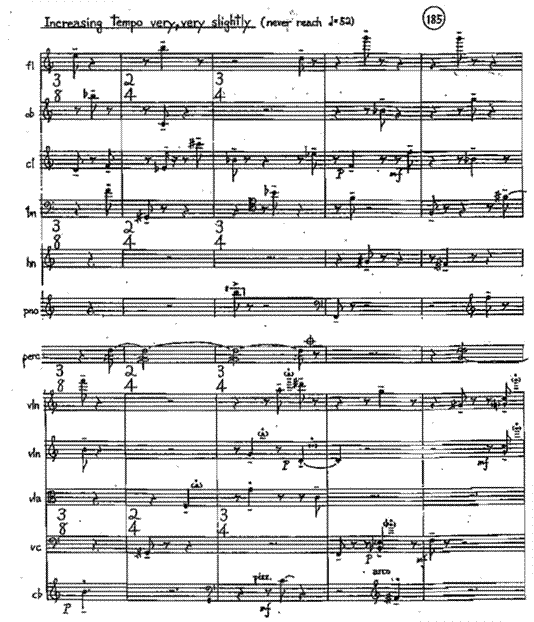
Example
63: When
Wind Blew:
page 28, measures 181 – 185
Finally,
the highest note of the chord played by the first violin is clearly audible due
to its register being a minor ninth higher than the flute pitch. In general, all notes in When Wind Blew
are heard clearly because they are fixed in certain registers which gives them
space to sound as single entities.
In the
first beat of the following measure (m. 182), a low G# is doubled by bassoon
and cello. Unison doubling here plays a very important role in terms of giving
timbral identity to sound events. Due to its frequent repetition throughout the
composition, this sound combination is heard as a tentative tonal center.
The next
three-note chord in this measure (ignoring for the moment the inclusion of the
non-standardized pitch of the cow bell as part of the chord) is very widely
spaced and functions in a similar manner to the four-note chord in measure 181
explained above. The pitches of the final two-note chord played by viola and
clarinet in measure 182 are clearly audible due to their contrasting register (a
minor ninth apart) and color. In the first beat of measure 183 there is a high
B natural played on piano two octaves and a semitone above a B flat played on a
clarinet. This is followed by another widely-spaced two-note chord for viola
and violin one octave and a perfect fifth apart. In the same manner as the
chords from measure 181, the two notes of each of these two chords are clearly
audible as autonomous sounds.
Continuing
to the next chordal formation in this measure, the pizzicato contrabass
tone played in combination with the violin harmonic and a pitch played by the
bassoon in a high register, creates a three note formation (C, E and B ). Again as examined in the chords above, these
three pitches are clearly audible due to their distinctive timbre and
intervallic distance from each other. The remaining vertical formations in this
excerpt need not be explained in detail as they function in the same manner as
formations described above.
We
conclude the analysis of this passage with reference to the two sustained
cow-bell tremolos. The inclusion of the cowbells into an otherwise conventional
ensemble is a device used by Kondo to offset the listener’s expectation, and to
add an unstable element into an otherwise conventional sound world. These
sustained cow-bell tremolos function as a kind of pedal tone to the surrounding
pitches of the other instruments.
Because of the extended duration of these tremolo passages throughout
the work (the longest sounding continuously for 57 measures), the ear tends to
hear these pitches as tonal centers. Shorter tremolo passages are sensed as a
kind of pedal tone. In both cases, the presence of the sustained cow-bell tones
has the effect of changing the way the listener perceives the intervals played
by all of the remaining instruments. Certain intervals which have strong
binding tendency with the cow-bell tones (unison, octave, perfect fourth,
perfect fifth, and major third) are clearly emphasized, which has the overall
effect of strengthening the sense of tonality or modality. A very important
element of indeterminacy which must not be overlooked in this work, is the
composer’s decision to not specify the pitch of the two cow-bells.
This indeterminate element adds a certain elasticity to the composition as each
performance is heard in a slightly different manner depending on the particular
choice of pitches of the cow-bells.
Repetition
and variation play an important formal role in When Wind Blew serving to
anchor certain chords and events in the listener’s ear in order to add
familiarity in an otherwise completely abstract sound world. In this work a
great amount of literal repetition of specific intervals and durations occurs,
but these repetitions are relatively veiled because they are not punctuated by
breaks of silence or changes in texture, and the orchestration of this repeated
material is continuously varied throughout the composition.
Literal
repetition is explained by the composer as “in itself static, leading to
nowhere, while variation, if arranged logically as in classical music, has a
directional and developmental dynamic of its own, what we call a ‘good
discourse’.”
If we compare two sections of the work, which are virtually identical in terms
of the specific durations of musical events and pitch material, we can see
clearly how Kondo achieves great musical effect through variation by colorful
re-instrumentation (Examples 64 and 65).
As we can
see from glancing at Examples 64 and 65, the pitch material and gestures of
each example correspond quite closely. We could term this very subtle variation
of musical material a form of “pseudo-repetition.” Here, the material of
Example 65 is so similar to the material of Example 65 that the listener is
hard pressed to determine where the musical variation occurs. The material of
Example 64 will be compared with the corresponding material of Example 65 using
the following measure pairings: 17/30, 18/31, 19/32, 20/33, 21/34, 22/35 and
23/36.
Measures
17 and 30: Apart from the inclusion of the cow-bell tremolo, measure 30 is identical
to measure 17 with the material of these measures being comprised of a two-note
chord played in harmonics by the contrabass and the first violin.
Measures
18 and 31: The chord in measure 18 played by the flute, oboe and clarinet is
re-orchestrated for strings in measure 31 played now by the second violin,
viola and cello.
Measures
19 and 32: The three-note chord played by the flute, clarinet and horn in
measure 19, is later played by the clarinet and two strings in measure 32.
Measures
20 and 33: The two-note chord in measure 20 played by the clarinet and horn is
played in measure 33 by the flute and the clarinet.
Measures
21 and 34: A two-note chord played in harmonics by the cello and contrabass in
measure 21 is played by three instruments in measure 34 with the contrabass
playing the same note from measure 21 but doubled now by the clarinet. The
flute replaces the cello in bar 34 completing the two-note chord.
Measures 22
and 35: The E in the first beat of measure 22 played by the oboe is later
played by the horn in bar 35. The two piano pitches and single pizzicato
contrabass pitch played in the second beat of measure 22 are altered slightly
in measure 35 with one of the piano pitches being played now by the clarinet. The
oboe and clarinet play the two-note chord in the last beat of measure 22. In
the corresponding measure 35, while the oboe note remains, the clarinet pitch
is played now by the bassoon.
Measures
23 and 36: Measure 23 and 36 are virtually identical apart from a very subtle
change in color introduced in the latter measure through the doubling of the
harmonic played by the contrabass with the flute.
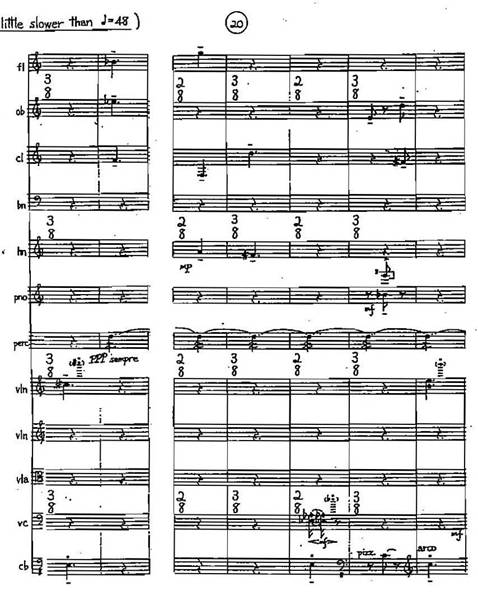
Example
64:
When Wind Blew: pages 3 and 4, measures 17 – 23
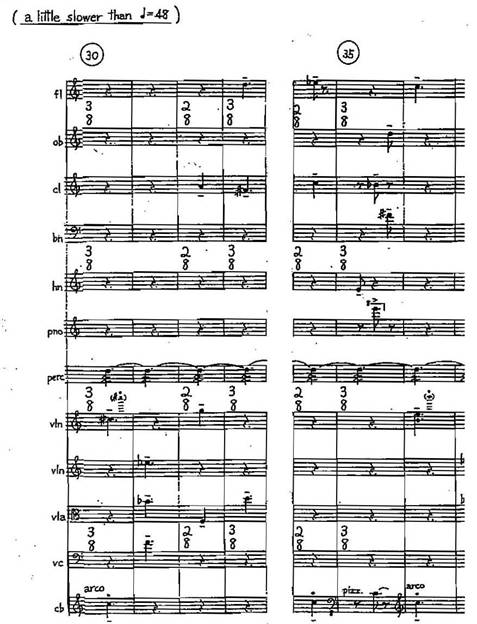
Example
65: When
Wind Blew:
pages 5 and 6, measures 30 – 36
Literal
repetition of durations and pitch material of much shorter lengths than the
above examples can be found throughout the composition. The frequent repetition of even single
measures of material is also used in this work to great effect. These repeating gestures act as signposts for
the listener who might feel somewhat lost from time to time in the relatively
abstract sound world of Kondo’s music.
We have already discussed the function of the low pitches played by
combinations of bassoon and cello (G#).
We will conclude our analysis of repetition and variation in When
Wind Blew by examining in detail a certain three-note vertical aggregate
which is very clearly audible throughout the work due to its distinctive fixed
timbre and register.
This three-note
aggregate in the last third beat of measure 9 of the composition is heard no
less than fifteen times throughout the work, but due to the continual variation
of the chord by instrumentation, the ear does not tire of it (Example 66).
The
measure numbers and corresponding instrumentation of the chord throughout the
work are listed below. If no beat
indications are included the chord lasts for the duration of the measure (see
Figure 1).
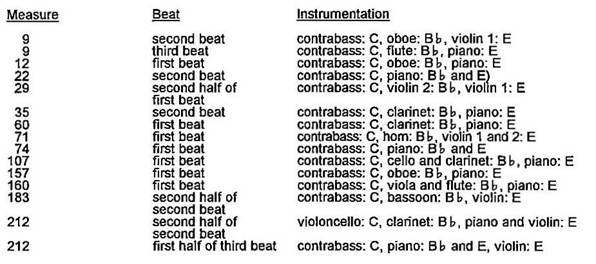
Figure 1: Orchestrations
of a Three-Note Aggregate from When Wind Blew
As can be
seen in Figure 1, changes in instrumentation with the pitches and durations of
pitches left intact for formal clarity. This manner of working is one
manifestation of the composer’s idea of “pseudo-repetition” used to achieve
“dynamic stasis.” While there appears to be very little change of events over
time, looking closely at the work we can discover the elements of “hidden
change” which are so essential in Kondo’s music - the subtle musical details
that give life to a relatively static and sparse, non-teleological music devoid
of musical climax and conventional development.
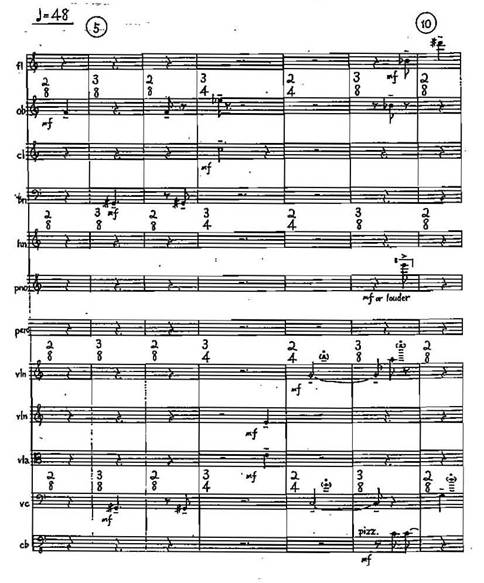
Example
66:
When Wind Blew: page 2, measures 4 – 10
Conclusion
This study
has examined the origin and early development of the music of Jo Kondo through
an analysis of the works written in the composer’s sen no ongaku style
from 1973 to 1980. A clear understanding of the development of Kondo’s music
through this period is important as the results of this development can be seen
in works written from 1981 to the present. The essential aspects of sen no
ongaku discussed here include: the concept of building a composition on a
single melodic line, static form, the experimentation with a new kind of
continuity based on an “endless pulse,” and the encouraging of a more active
kind of listening to music from instant to instant by grouping sounds in
non-hierarchical formations.
Mr.
Bloomfield His Spacing (1973) is seen as an important pivotal work
displaying aspects of both pre-sen no ongaku style and sen no ongaku
style, and the radical shift in style in this year. Orient Orientation,
is considered in detail (Appendix A) as the earliest manifestation of sen no
ongaku and a series of works of the period 1973 to 1980 were examined from
many different angles including the various forms of melodic writing, Kondo’s
treatment of rhythm, harmonic aspects, larger structures and overall form.
Sight
Rhythmics
(1975) was treated in detail as the first sen no ongaku work in which
the composer was consciously concerned with problems of form, in particular its
break from the uni-sectional static form of all previous works and the new
possibilities it offered in its succession of separate movements, From the
composition of this work on, Kondo abandoned the use of pre-compositional
gamuts and started to compose in a completely intuitive manner. This was also
the beginning of the composer’s experimentation with ‘pseudo-repetition’, a
very important compositional device which later surfaces in subsequent works
throughout the composer’s oeuvre.
One of the
most striking aspects of the composer’s sen no ongaku style is the
paring down of material to a bare minimum in order to focus the listener’s
attention on very subtle changes from measure to measure. Most of the works
discussed here, written in uni-sectional static form, can be likened to
laboratories for experimenting with the musical potential of a certain
technique, such as dance-like rhythm, shadow or hocket technique,
non-functional harmonic movement in the form of ‘hanging chords’ and textural
contrast. The mature works composed from 1978 to 1980 are distinguished by their more refined
hocket-like movement between voices, greater sensitivity to harmonic relations
and very subtle balance of linear and horizontal elements.
Another
striking aspect of structure in Kondo’s music is its virtual lack of a
polyphonic texture and its corollary, the consistent use of rhythmic unison
writing. This is a very conscious
decision made to encourage the listener to hear sound events as individual
entities rather than as merely parts of a greater structural whole. A contrapuntal texture clearly blurs this
focus, so Kondo opts to link all sound events vertically in order to encourage
the listening of sound events as single entities. In later compositions written after 1980,
while these single sound events become thicker, the consistent use of rhythmic
unison and complete lack of counterpoint, ensures that these sound aggregates
are heard as individual sound events with their own singular identity apart
from other sound events making up the composition.
The first sen
no ongaku work, Orient Orientation, for any two melody instruments
of the same kind, sounds on first listening like "a row of endless tones
that proceed without interruption, always wrapped out in a kind of simple
artlessness" as Kondo
writes in the liner notes of his first LP album to explain the features of his
new style. On closer inspection however,
we are aware of a concise formal plan, a very particular control over rhythm
and pitch relationships, and a clearly 'artful' playing with material that is
characteristic of all the composer's work from 1973 to the present. Most important, this is the first work to
employ throughout the entire composition, a consistent use of rhythmic unison
which is one of the most conspicuous aspects of sen no ongaku style,
running through the composer's entire body of work.
The
distinctive sound world of Orient Orientation is produced by the strict
limitation and fixation of musical elements. Only one gamut consisting of
fifteen pitches of fixed range is used in this composition. The use of a single
tempo indication, along with the lack of any crescendo, decrescendo or other
expression markings, helps to maintain a uniform musical field without textural
and dynamic contrast. Due to the complete absence of expressive gestures, and
the meandering quality of its movement in time, the music has little sense of
forward momentum, with sounds gently entering and receding as if placed in
time, rather than composed. This consistent lack of goal‑oriented melodic
movement likens the piece to an almost 'static field' of musical events.
Thus one
of the more radical aspects of this first “linear music” work is its complete
rejection of any kind of emphasis on the composer's subjectivity in the form of
emotive or expressive musical gestures. As an alternative this music,
"born neither of awe nor emotion," relies on a
subtle play of rhythm and formal conciseness to structure and shape the musical
image.
The sound
world of Orient Orientation is organized in such a way that minute
irregularities and shifts in focus become loci of attention. Examples of this include: asymmetrical
rhythms, unexpected harmonies, continually varying lengths of durations of the
shadow tones, alteration between rhythmic unison at the octave and rhythmic
unison at other intervals, and shifting nuclear tones. To enable this attention
to detail, Kondo sets up a field of continuously shifting sound events of more
or less equal emphasis and stress. If certain gestures predominate too
strongly, they become focal points upsetting the delicate balance established
between sound events.
Orient
Orientation is comprised of four sections clearly delineated by
breaks of silence. These sections are distinguished from each other in terms of
the way the material in each of the sections is treated. The first half of
section one is written in strict unison between the two instruments, with the
second half of the section employing hocket technique (Example 1). Section two
is written using the hocket technique only (Example 2). Section three is
written in strict unison between the two instruments for the most part, with
the intermittent use of a few other intervals throughout the section (Example
3).
Section four employs the hocket technique once again before a short ending in
rhythmic unison (Example 4). As can be seen from viewing Examples 1 to 4, apart
from the contrast between the techniques of unison writing and the hocket
technique, the four sections of this work sound very much alike. Due to the
lack of dynamic and textural contrast, and non‑teleological continuity,
the work as a whole is generally heard as one long continuous strand of music
with brief interruptions rather than a composition written in four distinct
sections.
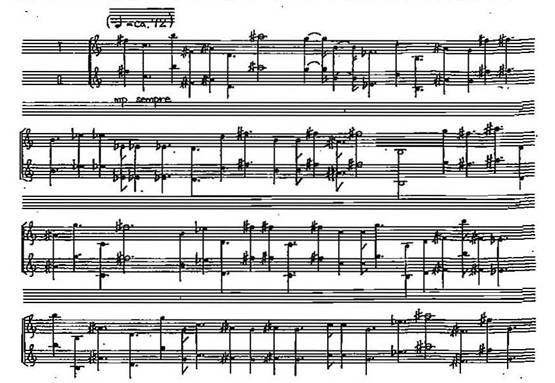
Example 1: Unison
Writing in First Half of Section One, Orient Orientation: page 1, systems 1 ‑ 4
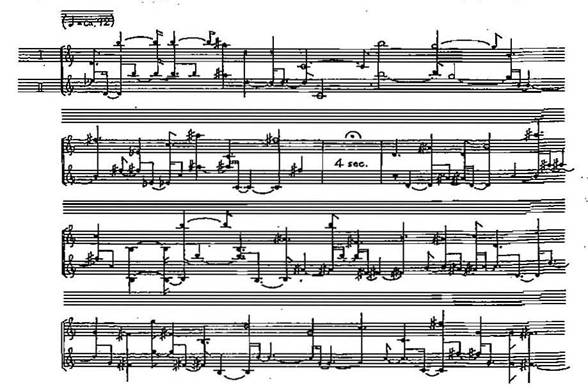
Example 2: Hocket
Technique in End of Section One and Beginning of Section Two, Orient Orientation:
page 2, systems 5 ‑ 8
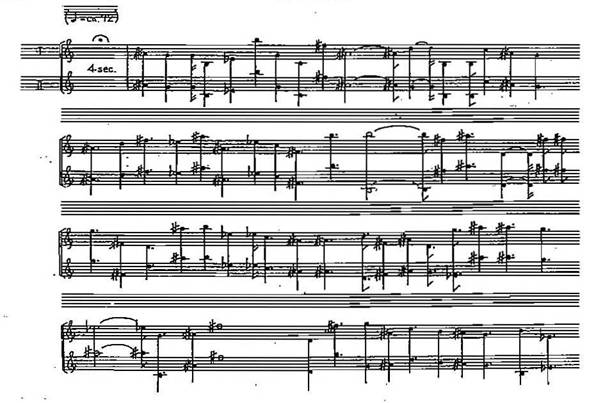
Example 3: Rhythmic
Unison Writing in First Half of Section Three Using Combinations of Unison and
Other Intervals, Orient Orientation: page 3, systems 5 ‑ 8
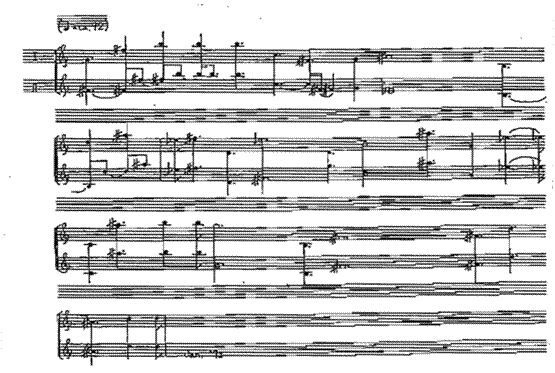
Example 4: End of
Section Four Using Both Hocket Technique and Rhythmic Unison Writing, Orient
Orientation: page 5, systems 5 ‑ 8
Orient Orientation
is the first composition to employ “static form”, or to be more precise, uni‑sectional
static form. The small breaks of silence
in this composition are merely the arbitrary openings and closings of a door to
an endless stream of sound. Listening to
the first few bars of Orient Orientation can be likened to the
experience of entering a concert hall in mid‑performance. Because this is non‑teleological music,
without clear destination points or any sense of development, other means must
be employed to move the music forward in time.
This is achieved through the particular harmonic and melodic relations
between pitches, and a subtle play of rhythm. As in all early sen no ongaku
works, the pitch material and pitch range of Orient Orientation is relatively
limited which serves to unify the composition and create its distinctive
atmosphere. The gamut of sounds chosen
prior to composition is made up of the seven notes B, C, D, Eb, F#, G, and A#. These notes are arranged over two octaves in
the following fifteen note gamut (Example 5):

Example 5: Orient
Orientation, 15-Note Gamut
The
melodic line running through the entire work is generated from this gamut using
random procedures. Kondo explains that if each sound of a melodic line is
chosen by a random method, the distribution of sounds becomes somewhat biased,
emphasizing "some specific pitches at the expense of others, with the
result that some of them almost sound like nuclear tones (or even tonics) in a
tonal composition." So while "the gamut itself cannot really be
called modal or tonal, the way of choosing each successive pitch from the gamut
gives us this feeling." Kondo's
method of choosing groupings of pitches from his gamuts of randomly derived
tone rows is quite intuitive. Far from restricting the choice of pitches to a
fixed ordering of tones, Kondo chooses to omit any portion of the row which he
feels is "too obvious or too vague in its tonal feeling, so as to obtain
the right degree of tonal ambiguity." This tonal
ambiguity is achieved by carefully regulating the occurrence of nuclear tones
throughout the work.
Examining the frequency
of occurrence of all the pitches of the composition can shed some light on
Kondo's manner of achieving a proper balance of "tonal ambiguity"
throughout the work. Below is a chart showing the frequency of occurrence of
all the pitches in the work by section (Example 6). Within each section,
certain tonal centers are suggested by the frequency of occurrence of certain
tones. In Section 1, B is the tone sounding most often. The most frequently
sounding tone in Sections 2 and 3 is A#. F# becomes the tone with the highest
frequency of occurrence in Section 4. Viewing the Total column, we can see that
the three pitches F#, A# and B have the highest frequencies of occurrence. Over
the course of the piece, due to this comparatively high frequency of occurrence
(in relation to the remaining four pitches C, D, E flat,G), they are sensed as
a kind of collective pitch center. These three pitches are highlighted all the
more strongly because the remaining pitches share a lower, and comparatively
similar frequency of occurrence over the course of the work (68, 66, 58 and 60
total occurrences respectively).
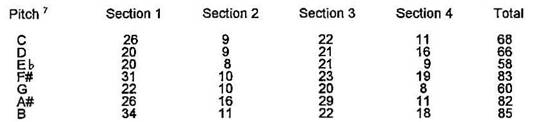
Example 6:
Frequency
of Occurrence of All Pitches in Orient Orientation
We can
also see from Example 6 that all pitches are relatively evenly distributed
throughout the work. While certain pitches occur more frequently than others,
pitch hierarchies are generally avoided so as to create "the right degree
of tonal ambiguity." If one note in a section is too predominant, the ear
focuses on this pitch as a tonal center with other tones being reduced to an
auxiliary function. In this case the delicate sense of balance between all
pitches in the section is lost. When listening to Orient Orientation,
due to the relatively even distribution of pitches, the ear, which is generally
accustomed to searching for recognizable patterns, is often at a loss when
trying to determine the most prominent pitches within groups of tones.
Kondo
shifts the distribution of pitches slightly within sections.
This is in fact a standard variation technique (variation by section), but
dealt with in a very subtle manner. Due to the close resemblance of all
sections, without attentive listening, it is hard to distinguish one section's
central pitches from another's. However, these shifts of pitch distribution
create a slightly different harmonic emphasis in each section which helps to
move the work forward in an otherwise completely static harmonic field. This
manner of pitch distribution is one way of avoiding harmonic or melodic
development. The absence of a clear tonal center also reinforces the autonomy
of individual tones. If all tones in a section are distributed evenly in a non‑hierarchical
manner, the ear tends to focus on the pitches as individual entities rather
than as smaller pieces of larger melodic or harmonic units.
Kondo's
gamut is used to generate vertical as well as horizontal note groupings. While
the piece is primarily melodic, with both instruments playing for the most part
in unison and slightly unsynchronized unison, occasionally, two‑note
vertical formations result from the playing of a non‑unison pitch in
rhythmic unison as seen in Example 7.
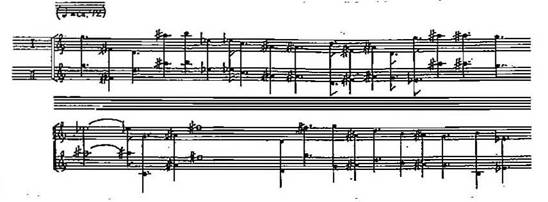
Example 7:
Orient
Orientation: page 3, systems 7 and 8
These two‑note
chords are used to introduce very minor shifts in harmonic focus at certain
points throughout the work. The second pitch
merely colors the primary pitch, and in no way disturbs the linear motion of
the line. This is the first introduction
of Kondo's technique of 'hanging' a secondary note from a tone of a melodic
line, a technique which is used in later work in a more developed way by
hanging chordal formations from single tones.
Vertical
formations in this composition are in no way connected with functional harmony.
This can be seen clearly by gathering together all the occurrences of two‑note
chords in the work to search for possible hierarchical connections (Example 8).
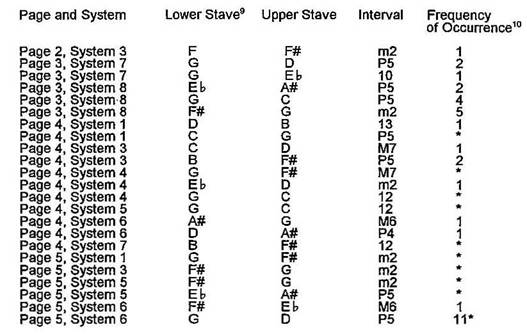
Example 8:
Frequency
of Occurrence of Two‑Note Chords in Orient Orientation
Viewing
this chart we can see that there is a relatively even distribution of two‑note
chords of different identity throughout the work. This even distribution of
chords is very similar to the even distribution of pitches shown in Example 6. While
the chords C/G and F#/G are the most frequently occurring chords in the set,
due to their random distribution throughout the composition, they are not
sensed as tonal centers and therefore cannot be considered as part of a
hierarchical harmonic system.
Another
form of incidental harmony results from the crossing of two melodic lines when
playing out of strict unison (Example 9).

Example 9: Orient
Orientation: page 1, system 7
Here in Example
9 we see Kondo's technique of shadow articulation in operation, with the upper
voice leading and the lower voice following the upper voice in an irregular
rhythmic pattern repeating the notes B, C, C, A#, F#, B before arriving
together in unison on F#. The shadow notes in the lower voice are always held
through the following notes in the upper voice until the next shadow
articulation which has the effect of creating a slight harmonic blurring. Due to the slight time lag between the two
voices a fleeting two‑point counterpoint is formed. This is the first
appearance of Kondo's "pseudo‑polyphony." The resulting
harmonies are not sensed as distinct harmonies in the same manner as the two‑note
chords previously discussed because they clearly result from the linear
movement of the two instrumental lines. However, this blurring of lines through
the overlapping of voices adds an important element of ambiguity to the work. Kondo
is interested in setting up a musical environment in which the listeners, confronted
with an ambiguous harmonic field, are able to form their own individual
interpretations of the vertical groupings throughout the work.
In Orient
Orientation, rhythm plays an equally important role in maintaining a
delicately balanced non‑expressive field of musical events by reinforcing
the autonomy of individual tones. Orient Orientation employs additive
rhythm only; divisive rhythm (the division of a note into unsymmetrical parts
such as triplet, quintuplet, etc.) is not employed in this work. Thirteen units
of duration are used starting from the shortest duration of a sixteenth‑note
to the longest duration of a dotted whole note. For ease of recognition these
note durations are reduced to numbers on the lower line of the following chart
(Example 10).

Example 10: Durations Used in Orient
Orientation
Kondo states that
this work uses the dotted quarter note as a standard duration.
This dotted quarter note can be considered a kind of nuclear duration in the
form of a standard pulse which is augmented or diminished to make up the
remaining twelve durations of the work. We know that Kondo did not resort to a
pre‑compositional system to organize the frequency of occurrence of the
thirteen durations as he mentions that "the rhythmic aspect of Orient
Orientation was all freely (i.e., intuitively) composed."
It is important to
note that the stringing together of the units of duration throughout the work appears
to function almost as an independent system, meaning that particular durations
in this series are not inextricably tied to particular pitches of the pitch
gamut. Kondo decides against a
systematic method of determining note lengths in the work and is careful to
arrange his durations in a manner that suggests audible quasi‑melodic
connections between tones. Below is a chart listing the consecutive durations
of all the notes in the first unison section which begins the work. This chart is to be read top to bottom and
left to right (Example 11).

Example 11: Consecutive Durations
of Pitches in First Unison Section of Orient Orientation: page 1
The nine durations of
the pitches used in the first unison section in order of highest frequency of occurrence
are as follows: 4 (46), 6 (32), 8 (6), 2 (7), 5 (4), 12 (3), 10 (1), 16 (1),
and 24 (1). hile the quarter‑note
durations clearly predominate, due to Kondo's random method of arranging these
nine durations in this section, these quarter notes are never successively
aligned in groupings of more than three pitches. The dotted quarter‑note
durations follow the same general rule as the quarter‑note durations, by
being restricted from successive alignment of more than one or two pitches. This
restriction on the number of durations being allowed to align consecutively has
a very important structural function.
Because the
repetition of durations suggests a regularly recurring pulse, it is able to aid
in the grouping of tones in melody‑like configurations. Pulses within a random field are particularly
important in terms of implying melody as Cooper and Meyer explain: "All
pulses in a series are by definition exactly alike. However, preferring clear
and definite patterns to such an unorganized potentially infinite series, the
human mind tends to impose some sort of organization upon such equal
pulses." While these pulses clearly
aid in perceiving melody‑like groupings of tones, because these
configurations of recurring pulses never last for more than three or four
beats, the melody‑like groupings are continually broken off just after
they begin. Due to the relatively random asymmetrical arrangement of durations,
the listener is never quite sure when one melody begins and another ends. The
ephemeral quality of the melody disappearing soon after it has begun, its
uncertain beginning and end points, and its clear lack of teleological
continuity are the three conditions which prevent pseudo‑melody from
entering the category of conventional melody.
Continuity in Orient
Orientation is achieved through the incessant linking of the single tones
of the pitch gamuts in continually varying durations throughout the work. Kondo
refers to these continually varying durations as "quasi‑determined
units of duration." In opposition to this are "determined units of
articulation" which refer to conventionally organized rhythmic groupings
of sounds with clearly recognizable rhythmic patterns and strong teleological
continuity. Kondo discusses "quasi‑determined units of
duration" in terms of the continual variation of beat length.
It is the stringing together of beats of varying duration, rather than rhythmic
patterns, that creates, in Kondo's words, a "continuity based on an
endless pulse."
Along with pitch
ordering, rhythm plays an equal if not more important role in contributing to
the self‑sufficiency of single tones in Orient Orientation. Our discussion will begin by touching on
Cooper and Meyer's theory of rhythmic structure, which most probably informed
Kondo's thinking in the mid 1970's when he was formulating his theory of sen
no ongaku. In his discussion of how the grouping of musical events or
"stimuli" create the sensation of rhythm, Cooper and Meyer mention
that "if the successive stimuli are so different from one another or so
separate in time or pitch that the mind cannot relate them to one another,
there will be no impression of rhythm. The stimuli will then be perceived as
separate isolated tones."
Kondo is interested in
drawing attention to single tones in Orient Orientation, but this is not
to imply that rhythm must be abandoned altogether to achieve this aim. Rather,
Kondo uses asymmetrical rhythm consistently throughout this work to set up a
field of tones hovering between conventional melody and an almost random
sounding constellation of individual tones. Cooper and Meyer's idea of the
relation between the distance between pitches and the comprehension of rhythm,
is touched on in a concrete way in this composition. The distance between the
tones of this work are close enough to suggest definite rhythmic (or melodic)
groupings, but not regular and periodic enough to qualify as conventional
rhythm (or melody). One of the most important functions of asymmetrical rhythm
in this work is to set up an ambiguous rhythmic environment in which single
tones can be heard in two ways simultaneously ‑ as single independent
tones, and as pitches in pseudo‑melodic groupings. Let us refer to an
example from the score to examine in detail how rhythm contributes to the self‑sufficiency
of single tones (Example 12).
Segment A of this
example sounds like a conventional musical phrase due to the very strong
quarter‑note pulse resulting from the inclusion of eight quarter‑note
durations in a grouping of ten notes. The quarter‑ note pulse is broken
only briefly by a single sixteenth‑note which sounds very much like a
grace note to the fourth note of this segment. The final A# sounds very
cadential due to its relatively long duration compared to the quarter‑
note pulses. This segment resembles conventional
melody in many ways. A reasonably short phrase length aids the ear in sensing
the ten pitches as a single melodic grouping.
There is also a regular pulse, a clear melodic shape, and a strong
cadential figure closing the phrase. If this manner of phrasing had been
employed
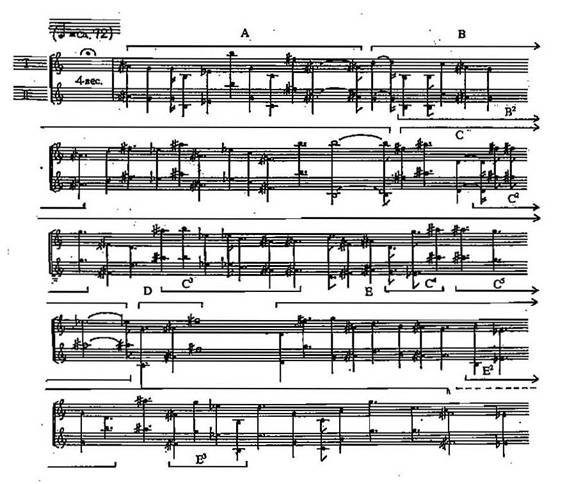
Example 12: Orient
Orientation: page 3, systems 5 ‑ 8 and page 4 system 1
throughout the entire work, the composition
would differ little from a relatively orthodox piece employing conventional
melodic structuring. But from the
beginning of segment B, a fair amount of rhythmic variation is introduced which
creates noticeable rhythmic and melodic instability.
Segment B could be
said to resemble segment A in its use of a markedly long final duration which
functions as a cadence which is also greatly strengthened by the low B. But the
string of notes, being nearly twice as long as segment A, is not so easily
heard as a distinct melodic phrase. The
variations in note durations here prevents the listener from grouping the tones
together in a hierarchical manner. Therefore, in this case, the individual
tones achieve an independence that they lack in segment A. However, with the introduction of the final
note, which is unequivocally cadential in feeling (in the same manner as the
cadence at the end of segment A), this line is retroactively sensed as a
melodic unit. Segment B is a clear example of how irregular rhythmic pacing is
able to contribute to the delicate balance between pitch autonomy and pseudo‑melodic
grouping. In this string of tones, there are very clear syntactical connections
between pitches, but at the same time, due to their lack of hierarchical
grouping, and clear absence of directed continuity, these pitches cannot be
said to operate in the same manner as conventional melody.
Segment C is even
more rhythmically ambiguous than segment B. With the absence of clear cadences
throughout this lengthy string of tones, the ear has difficulty in attempting
to arrange these pitches into melodic groupings. Thus the syntactical devices
of “musical phrase,” “”sentence” or “period” cannot apply here. This segment is characterized by very
asymmetrical rhythmic grouping, with little or no conventional melodic
attraction to cadential end points, giving the tones in this section much more
independence than the tones in the preceding two sections. This string of
independent or self‑sufficient individual tones, viewed in its entirety
is representative of the 'static field' continuity referred to earlier in this
study. At the end of this segment is a strong closing cadence incorporating a
perfect fifth, but arising even more unexpectedly that the cadence at the end
of segment B.
Segment D is heard
as a distinct phrase due to the clearly audible grouping of three durations
with a definite melodic shape. Segment E is very similar to segment C in terms
of its manner of continuity. A long string of twenty‑three tones of the
varying durations of quarter notes, dotted quarter notes and a single eighth
note are heard before reaching the largest duration of a half note. But this half note, being very close in value
to the preceding dotted quarter notes, does not sound like a point of rest as
explicitly as the final quasi-cadential final pitches of segments A, B, C or D.
It is rather sensed as a short pause, or provisional point of rest, between a
more cadential‑sounding dotted quarter note three and a half systems
later.
Viewing all the
segments of this example together we can see that the tones of segments A, B
and D form more or less conventional melodic groupings, while the tones of segments
C and E have a markedly stronger independence than the tones of the other
segments. This balancing of segments written in conventional melodic style,
with segments written in a pseudo‑melodic manner is very important in
terms of creating ambiguity on a macro‑structural level. Depending on the manner of listening, these
segments can also be broken down into smaller middle structures delineating
audible groupings of tones as shown by B2, C2, C3, C4, C5, E2 and E3.
There is one more
level of rhythmic detail in Orient Orientation which helps to encourage
the independence of tones. This is the asymmetrical rhythm of the repeated
shadow tones. The varying shadow tone durations throughout the work create
another independent level of rhythmic articulation which we will refer to as
“sub‑rhythm.“ This asymmetrical sub‑rhythm of the shadow tones
contributes very strongly to the autonomy of single tones (Example 13).
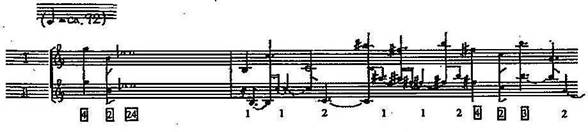
Example 13: Asymmetrical Sub‑Rhythm
of the Shadow Tones, Orient Orientation: page 1, system 7
The numbers written
below the staff of Example 13 represent the length of time in sixteenth‑notes
between the sounding of the tone in the upper voice and the sounding of its shadow
tone in the lower voice. Numbers in quadrangles denote durations of unison
tones. In order to facilitate the quick viewing of all of the shadow tone
durations in the first section of the work employing the hocket‑like
shadow tone technique, rather than referring to the score which is somewhat
difficult to read quickly, the durations are arranged in numerals corresponding
to the durations in the chart of Example 10 (Example 14). (This chart is to be read from top to bottom
and left to right).
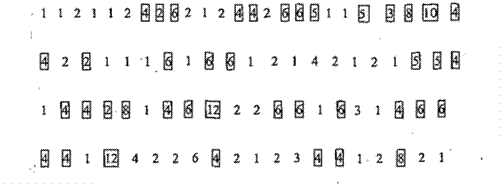
Example 14: Durations Between the
Sounding of Tones and Shadow Tones in Section One of Orient Orientation
(p. 1 system 7, second measure to p. 2 system 6, first
measure)
Looking at this chart
of durations of Example 14 we notice that in general, the shadow tones (numbers
not encased in quadrangles) lag one sixteenth‑note or one eighth‑note
behind the primary pitches with occasional interjections of slightly longer
durations of dotted eighth‑notes and quarter‑notes (represented by numbers
3 and 4 respectively). Unison tones in boxes are relatively evenly distributed
throughout the section adding yet another element of rhythmic variation to this
shadow tone section. The sound shadows contribute to the independence of the
single tones in the work by drawing attention to them through repetition in
irregular patterns. If the hocket‑like durations were all equal, the ear
would soon grow accustomed to them and consequently other syntactic elements
would come to demand the ears attention. But Kondo's hocket rhythm is so
irregular, that even after several listenings, the listener is unable to
predict the rhythmic placement of the shadow notes. As a result of the focus of
attention on these slight rhythmic details, the single tone is highlighted or
"dismembered" in Kondo's
words, from hierarchical groupings of tones.
In Orient
Orientation Kondo experiments with subtle shifts of rhythm to encourage a
new kind of listening. The use of "unregulated," beat lengths of
various durations throughout the composition compels the listeners to continually
adjust their focus of attention as the work unfolds. "This listening is
experienced as a journey of the appearance and disappearance of the nuclear
tones which completely transcends ones expectation. Depending on the 'listener'
and the 'way of listening' the usage is different."
Continual adjustment is necessary because fulfillment of expectation is
repeatedly circumvented. Certain
rhythmic groupings sensed by the ear as primary for a few beats, are soon
abandoned and replaced with other note groupings suggesting other rhythmic
configurations.
This
paper is take (with minor alternations) from the author’s Ph, D, Dissertation:
John Cole,“An Introduction to the Music of Jo Kondo: The Origin and Development
of his ‘Sen no Ongaku’ (Linear Music) Style,” Elisabeth University of Music,
January 2006 (424p.). Chapter two of the
dissertation treats the earliest definition of the term sen no ongaku,
while chapter three is an overview of the composer’s sen no ongaku style
seen through works composed from 1973 - 1980.
3 While
only one system is included in this example, it is important to note that this
short excerpt is structurally and stylistically representative of the work as a
whole. Almost all of Kondo’s
compositions up to 1980 are generally comprised of a single texture with very
few contrasting sections. For this
reason, all the examples in this paper are rather truncated.
4 Jo Kondo,
liner notes to Sen no Ongaku
5 Jo
Kondo, liner notes to Sen no Ongaku
6 Jo Kondo,
liner notes to Sen no Ongaku.
Because the role of the listener is so essential in terms of completing
the structure in the early sen no ongaku compositions, the best way to
fully grasp Kondo’s idea of “manifold positionings” within a sound space is to
listen to one of the early sen no ongaku pieces in its entiretly.
7 Jo Kondo, liner notes to Sen no
Ongaku
8 Both
terms are only briefly introduced in is explained later at length in the article
“Articulation” published in Episteme in 1977 (republished as a chapter
of his book Sen no Ongaku in 1979), the term “sound shadow” is not
treated in any depth in any other consecutive writings. In spite of its brief mention in the liner
notes to his first LP, due to its direct relevance to all the compositions
recorded on his first record album, and because of its obvious linkage to a
hocket-technique employed in various works written throughout Kondo’s career,
this author has decided to include a brief discussion of these terms.
9 See Jo
Kondo, liner notes to Sen no Ongaku .
10 The instrumentation of this work is for any three
melody instruments of different families.
11 Jo Kondo,
liner notes to Sen no Ongaku
15 The terms
“gamut” and “note row” are used interchangeably.
16 Schoenberg
explains his tone rows as “invented to substitute for some of the unifying and
formative advantages of scale and tonality .... the basic set functions in the
manner of a motive” (Style and Idea. London: Faber and Faber, 1984, p.
219). Kondo’s conception of a sen no ongaku row could not be further
from this form of row described by Schoenberg.
A sen no ongaku row is decidedly non-structural in that it is not
used to unify a work in any kind of architectonic manner. Rather, Kondo’s rows of tones can be thought
of as almost arbitrary collections of notes organized in such a way that the
listener’s attention is drawn to each individual note rather than collections
of notes forming melodies or motifs. In
the composer’s words: “Liner Music, considered as a row of tones articulated in
single note units, acquires a continuity based on an endless
pulse.” (Jo Kondo liner notes to Sen
no Ongaku.)
17 Jo Kondo,
liner notes to Sen no Ongaku.
18 Jo Kondo,
The Art of Being Ambiguous: From Listening to Composing,” Contemporary Music
Review, Vol.2, no.2 (1988), p. 19.
21 Kondo’s
University of York Music Press catalogue does not include mention of the use of
cowbells in this work, although according to the score, the instrumentation, is
2 violins, 1 viola, 1 violoncello, and 4 cowbells (of different pitch).
22 The
other works using graphic notation include modulation (1970), Breeeze
(1970), and Jo-ka (1986). The
instructions for Jo-ka are somewhat elaborate but not as involved as the
instructions for Mr. Bloomfield, His Spacing.
Works written after
1978 and up to 2000 using this notation are Ars brevis (1988), Vox
humana (1988), Pastoral (1989), Hypsotony (1989), Fern
(1990), Monochromy (1992), Petteia (1993), Pergola (1994),
Three Songs of the Elderberry Tree (1995), Winsen Dance Step
(1995), Durante l’inverno (1995), Quickstep and Slow Ending
(1996), Gardenia (1997), Nocturnal (1997), A Prospect of the
Sky (1997), Syzygia (1998), Pillars of Time (1999), and A
Shrub (2000).
Jo Kondo, Gardenia (ALM
records, ALCD-47, 1998), liner notes, p. 8.
The only other
composition written for instruments of non-fixed pitch entirely is Wait
(1973).
See Jo Kondo, liner
notes for Hunisuccle, p. 6.
1 Jo Kondo, Sen
no ongaku (LP ALM records, AL‑1,1974), liner notes translated by
Joaquim M. Benítez.
3 The
intervals in Example 3, in order of appearance are: perfect fifth, two octaves,
octave, octave, perfect fourth, tenth, perfect fifth, perfect fifth, minor
second, octave and octave.
4 This gamut
is included in Kondo's own description of this work in Sen no ongaku, p.
105.
5 Jo Kondo,
"The Art of Being Ambiguous: From Listening to Composing," Contemporary
Music Review, Vol. 2, no. 2 (1988), p. 20.
6 Ibid. p.
20. The two quotations in this paragraph
are loose reiteration of Kondo's earlier description of the function of his
pitch gamuts in Sen no ongaku.
See pp. 107 ‑ 114.
7 Unison pitches and unsynchronized hocket pitches
of the same tone are counted as single tones in this chart. That is to say, that in cases where two
identical pitches follow in close succession, only the first note is recorded,
as the second note is merely the 'shadow' tone of the first. Octave distinctions of the pitches are not
made here because, when listening to this very texturally uniform music, all
octaves of a particular pitch tend to be registered by the ear as equivalent in
terms of their function as nuclear tones.
8 This
shifting of the distribution of the pitches is not necessarily planned out in a
conscious manner. We know however, from
Kondo's writings, that he omits portions of the row in order to maintain
"the right degree of tonal ambiguity," so this author is assuming
that the composer also planned the distribution of the frequency of occurrence
of the pitches within sections through his listening "carefully to the
pitch row created by individual sounds chosen from a random chart..."
("The Art of Being Ambiguous...," p. 20).
11 See Jo Kondo, Sen no ongaku, p. 114.
12 Conversation
with the composer, Elisabeth University, July 25, 2004.
13 Because
the relatively even distribution of duration of this section is replicated in
the second unison section of the work, the analysis of this one section will
suffice to explain the general operation of rhythm in both unison sections.
14 Grosvener
Cooper and Leonard B. Meyer. The Rhythmic Structure of Music. Chicago:
The University of Chicago Press, 1960, p. 3.
15 For the
last three quotations see Jo Kondo, Sen no ongaku, p. 116.
16 Jo Kondo,
liner notes to Sen no ongaku.
17 Grosvener
Cooper and Leonard B. Meyer. The Rhythmic Structure of Music. Chicago:
The University of Chicago Press, 1960, p. 9.
18 It must be
remembered that this segment, along with the other segments delineated in this
example are all this author's interpretations of groupings (or non‑groupings)
of tones. When listening to this
excerpt, other listeners might extract completely different groupings.
19 Jo Kondo, liner notes to Sen no ongaku.
20 Jo Kondo, Sen
no ongaku, p.103.